Lot Splits, Bungalows, and the Missing Middle Housing
How lot splits on bungalow properties support Missing Middle housing by adding gentle density, flexible living options, and long-term value.
The housing crisis didn’t appear overnight. It crept in slowly — first as rising prices, then as shrinking choices, and eventually as a feeling shared by many buyers and renters that there simply isn’t a place for them anymore. Not a luxury condo, not a suburban sprawl home, but something in between.
That “in between” is what planners now call the Missing Middle.
What’s interesting is that one of the most practical ways to address this shortage doesn’t require massive construction projects or dramatic changes to neighbourhoods. In many cases, the solution is already there, quietly sitting on expansive residential lots — particularly under older bungalows.
One concept that brings this potential to the surface is the lot split.
The Missing Middle Isn’t Abstract — It’s Personal
When people talk about the Missing Middle, it can sound like planning jargon. In reality, it describes very real situations, for instance:
- A young couple who can’t afford a detached home but don’t want a high-rise condo.
- A family that wants space but not the commute.
- An older homeowner who wants to downsize without leaving their neighbourhood.
For decades, zoning rules pushed cities into extremes.
Either a property could hold one house, or it could have many units stacked vertically. The modest housing forms that once filled older neighbourhoods — duplexes, small multi-unit homes, compact detached houses — quietly disappeared.
Today, cities are trying to reverse that pattern. And one of the simplest ways to do so is by allowing existing lots to be used more efficiently.
So, What Is a Lot Split — Really?
A lot split is exactly what it sounds like: one residential property is divided into two legal lots, each with its own title. Once approved, each lot can be sold, built on, or lived in independently.
What makes lot splits different from significant developments is their scale. They don’t aim to transform an entire area at once. Instead, they allow neighbourhoods to evolve naturally over time — one property at a time.
From the street, a successful lot split often looks unremarkable. Two homes where there was once one. Same height. Similar setbacks. A continuation of the existing rhythm of the block.
That’s why lot splits are often described as a form of gentle density.
Why Bungalows Play Such a Central Role
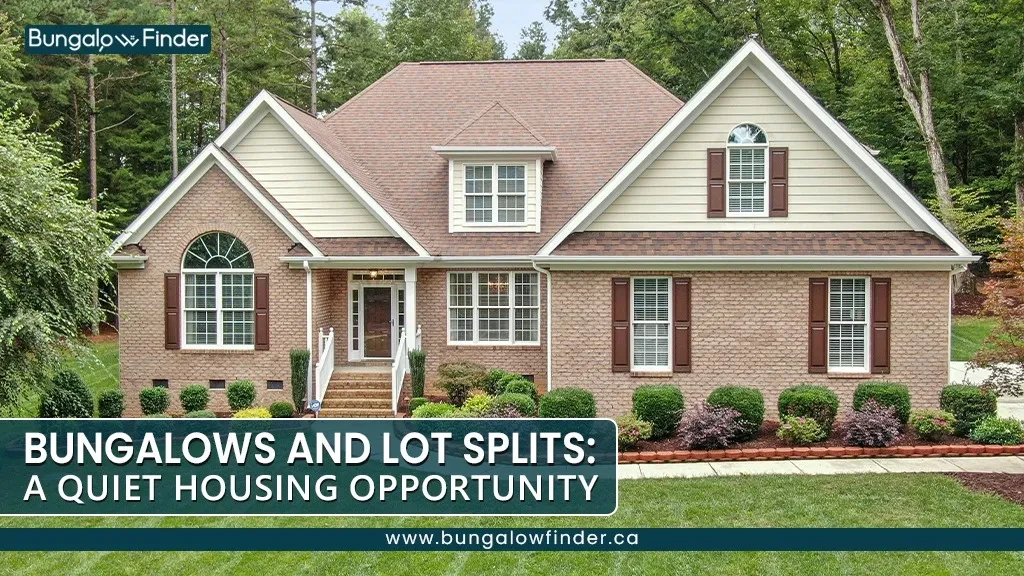
Not every property is suitable for a lot split, but bungalows frequently are. Many were built in an era when lots were broader, deeper, and more generously proportioned than they are today.
Because bungalows are typically single-storey, they offer flexibility in how land can be reimagined. In many cases, replacing one older bungalow with two appropriately sized homes feels more like a renewal than a disruption.
There’s also a practical side. Builders, buyers, and planners all understand the value of bungalow lots. They are easier to work with, easier to design for, and often easier to integrate into existing neighbourhoods.
At Bungalow Finder, we see this every day. Bungalows aren’t just popular because of their layout — they’re sought after because of what they allow over time.
How Lot Splits Support Missing Middle Housing in Practice
Lot splits don’t solve the housing crisis on their own, but they address a particular and stubborn part of it.
They add housing in places where people already want to live. They make use of existing roads, schools, transit, and services. And they do so without asking neighbourhoods to accept sudden, large-scale change.
Perhaps most importantly, lot splits often create homes that are more attainable. Smaller lots generally lead to lower purchase prices. That can mean an entry point into ownership for buyers who would otherwise be locked out of established areas.
This is the essence of Missing Middle housing: not luxury, not density for its own sake, but livable, human-scale homes that fit into real neighbourhoods.
Gentle Density Isn’t About Overbuilding
There’s often concern that increasing density means overcrowding. Gentle density challenges that assumption. It’s not about squeezing as much as possible onto a piece of land. It’s about allowing land to respond to changing needs over time.
A single lot split won’t change a neighbourhood. But across a city, hundreds of small decisions like these can add up to thousands of new homes — without towers, without sprawl, and without erasing the character that made these places desirable in the first place.
Bungalows, by their nature, are well-suited to this kind of evolution.
What Bungalow Owners Should Think About
For homeowners, the idea of a lot split often raises questions before it raises excitement. Zoning rules, approval timelines, servicing requirements, and costs all matter. Not every lot qualifies, and not every owner wants the same outcome.
Some see lot splits as a long-term investment. Others consider them as a way to help family members live nearby. Some simply want to understand the actual value of their property before selling.
The important thing is information. Knowing whether a bungalow has lot-split potential changes how it should be evaluated—and how it should be marketed.
Why Lot Split Potential Is Becoming More Important
As cities continue to adapt their planning policies to address the housing crisis, properties with flexibility are gaining attention. Buyers are thinking ahead. They’re asking not just what a home is today, but what it could be in the future.
Lot split potential adds a layer of resilience to a property. It doesn’t force a specific outcome, but it keeps options open — and in today’s market, options matter.
Where Bungalow Finder Fits In
Bungalow Finder exists because bungalows deserve focused attention. They sit at the intersection of livability, land value, and long-term potential.
Whether someone is buying, selling, or simply trying to understand how their property fits into the Missing Middle conversation, having a specialist perspective makes the process clearer and more grounded.
Final Thoughts
The housing crisis calls for solutions that are realistic, respectful, and repeatable. Lot splits meet those criteria. They don’t rely on sweeping change. They rely on thoughtful use of what already exists.
For bungalow owners, this is an opportunity — not just financially, but as participants in shaping healthier, more balanced communities. One lot, carefully divided, can be part of something much bigger.
FAQs
1. Do all bungalows qualify for a lot split?
No. Lot split eligibility depends on zoning, lot size, frontage, and local bylaws. Two similar-looking bungalows can have very different potential.
2. Do I have to tear down my bungalow to split the lot?
Not always. Some splits keep the existing home and add another, while others involve redevelopment. It depends on the lot and local rules.
3. Will a lot split change my neighbourhood?
Usually very little. Lot splits add low-rise homes that fit the existing streetscape, which is why they’re considered a form of gentle density.
4. Why do buyers care about lot split potential?
It adds flexibility and long-term value, even if buyers don’t build right away. Future options matter.
5. Is a lot split worth it financially?
It can be, but it depends on approval costs, timelines, and market conditions. Each property needs to be evaluated individually.