How AI Home Valuation Changes Bungalow Prices
Discover why traditional online tools underestimate single-story homes and how AI home valuation better reflects real buyer demand and value for bungalows.

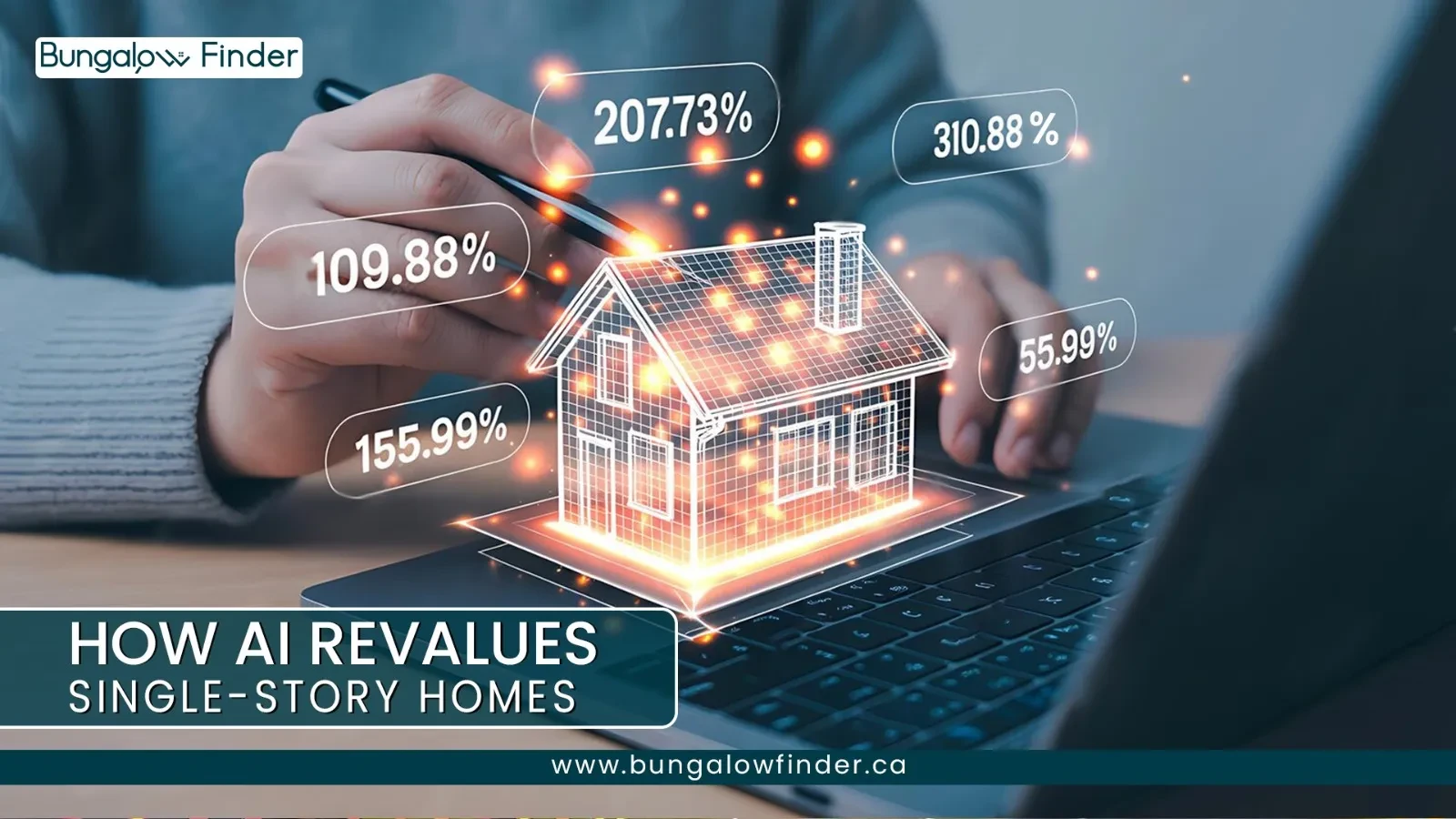
Single-story homes are often misunderstood by traditional online home estimates. This article explains why tools like the Zillow Zestimate don’t always reflect the actual value of single-story homes and bungalows, and how AI home valuation is changing pricing by focusing on layout, livability, buyer behaviour, and real renovation potential.
Why Single-Story Homes Often Feel Undervalued Online
If you’ve ever looked up the value of a single-story home online and thought, “That doesn’t feel right,” you’re not alone. This happens a lot with bungalows and single-level dwellings.
Most online valuation tools rely on historical sales, square footage, and basic property data. That system works reasonably well for standard homes, but it often misses what actually makes single-story homes desirable. Comfort, simplicity, and ease of movement matter to buyers, yet those qualities rarely show up clearly in automated pricing models.
Because of this, the value of single-story homes is often underestimated—or at least misunderstood—by traditional tools.
How Traditional Estimates Compare to AI Home Valuation for Single-Story Homes
Aspect | Traditional Online Estimates | AI Home Valuation |
|---|---|---|
Accessibility value | Not factored in | Included through buyer trends |
Renovation potential | Based on the current condition only | Considers realistic upgrade outcomes |
Buyer demand signals | Not included | Tracks views, saves, and time on market |
Accuracy for bungalows | Often inconsistent | More aligned with real buyer interest |
Pricing flexibility | Static | Adapts to market behaviour |
Overall insight | Snapshot estimate | Context-driven valuation |
This shows why single-story homes and bungalow homes' value often feels misrepresented online. Traditional tools answer “What sold before?” while AI real estate pricing focuses on “What buyers actually want now.” That difference is precisely where AI home valuation starts to uncover the actual value of single-story homes.
The Limits of Zestimate-Style Valuations
Online estimates like the Zestimate are meant to be quick reference points, not full valuations. They pull data from past sales, public records, and nearby comparables, then apply averages to produce a number that looks precise but lacks context.
What these models don’t do well is understand how a home actually lives. They don’t walk through the space. They don’t feel the flow. They don’t consider why buyers might choose one home over another, even when the numbers look similar.
This limitation shows up clearly when comparing single-story homes to two-story properties. A bungalow might have fewer square feet, but buyers may prefer it because it feels more open, accessible, and practical. Traditional estimates struggle to reflect that difference.
What Really Drives the Value of Single-Story Homes
The value of single-story homes is closely tied to livability. Everything is on one level. There are no stairs interrupting daily movement or limiting accessibility. Rooms connect more naturally, making the home feel easier to use and more comfortable over time.
This matters to a wide range of buyers. Families with young children appreciate visibility and safety. Older buyers value the ability to age in place. Even younger buyers are increasingly drawn to convenience and flexibility.
Layout efficiency plays a significant role, too. A well-designed single-story home can feel larger than it actually is, while a bigger but poorly laid-out home can feel cramped. Buyers pick up on this instantly, even if pricing models don’t.
How AI Home Valuation Changes the Picture
AI home valuation tools take a more modern approach. Instead of relying only on static data, they analyse patterns across listings, buyer behaviour, and market performance.
AI looks at how long homes stay on the market, how buyers interact with listings, which homes attract more saves or inquiries, and how pricing affects engagement. Over time, these systems learn what buyers actually respond to.
For single-story homes, this is a significant shift. AI can recognise that specific layouts and home types consistently perform better than expected. That performance becomes part of the valuation rather than being overlooked.
Why Buyer Behaviour Matters in AI Real Estate Pricing
One of the most significant advantages of AI real estate pricing is its ability to factor in real buyer behaviour. Instead of asking only what sold in the past, AI also looks at what buyers are doing right now.
Are people clicking on the listing? Saving it? Booking showings? Are similar homes selling faster or closer to the asking price? These signals say a lot about how buyers perceive value.
Single-story homes often perform strongly on these engagement metrics. Even when they look modest on paper, they can attract steady interest because buyers see long-term practicality. AI models can identify these trends and reflect them in pricing.
Bungalow Home Value and Renovation Potential
Bungalows are a perfect example of where AI valuation adds clarity. Many older bungalows have solid structures but dated interiors. Traditional estimates often focus on current condition, which can make these homes appear average or overpriced.
Buyers, however, often see opportunity. Single-level construction makes renovations more straightforward. Kitchens can be opened up, layouts can be modernised, and indoor-outdoor flow can be improved without the complexity of multi-story construction.
AI valuation tools can analyse how similar bungalows performed after realistic renovations. This helps bungalow home value reflect potential, not just present-day finishes.
Why This Matters for Sellers
For sellers, relying only on an online estimate can lead to mispricing. Single-story homes are often underpriced when their livability and demand aren’t fully recognised. That can mean leaving money on the table or positioning the home incorrectly.
AI-driven insights help sellers and agents price more confidently by aligning value with real buyer demand. It doesn’t replace local expertise, but it supports smarter decisions.
Why This Matters for Buyers
Buyers benefit from better valuation, too. When pricing reflects both condition and realistic potential, expectations are clearer. Buyers understand what they’re paying for and why.
This transparency reduces frustration and helps buyers focus on long-term livability instead of being distracted by surface details.
The Bigger Shift in AI Real Estate Pricing
AI isn’t replacing traditional valuation tools—it’s improving them. By factoring in layout, accessibility, buyer behaviour, and renovation outcomes, AI helps uncover value that basic estimates often miss.
Single-story homes benefit the most from this shift because their strengths have always been harder to quantify.
Final Thoughts
Zestimates and similar tools are helpful starting points, but they don’t tell the whole story. For single-story homes, actual value often lives beyond square footage and past sales. It’s found in how the house works day to day, how adaptable it is, and how long people want to stay.
AI home valuation is helping bring those factors into pricing conversations. And for bungalows and single-level homes, that means value is finally being measured in a way that feels closer to reality.
FAQs
Why do single-story homes often feel undervalued online?
Because most online estimates focus on size and past sales, not on how a home actually lives.
Is the Zestimate wrong for bungalows?
Not exactly—it’s just limited. The Zestimate gives a rough starting point, but it doesn’t fully capture layout efficiency, accessibility, or renovation potential, which matter a lot for bungalows.
How does AI home valuation do things differently?
AI looks at how buyers behave, not just what was sold before. It tracks interest, engagement, and performance patterns to understand why certain homes attract more demand than others.
Should sellers ignore online estimates completely?
No—but they shouldn’t rely on them alone either. Online estimates are a starting point. AI insights and local market knowledge help create a more accurate picture.
Are buyers actually paying more for single-story homes?
In many markets, yes. Buyers often prefer single-level living for practical reasons, and AI pricing tools are better at recognising that demand.