Mississauga vs Oakville 2026: Bungalow Comparison Guide
Comparing Mississauga vs Oakville real estate 2026? Get the full bungalow market comparison, including pricing, top schools, and ROI trends for buyers.

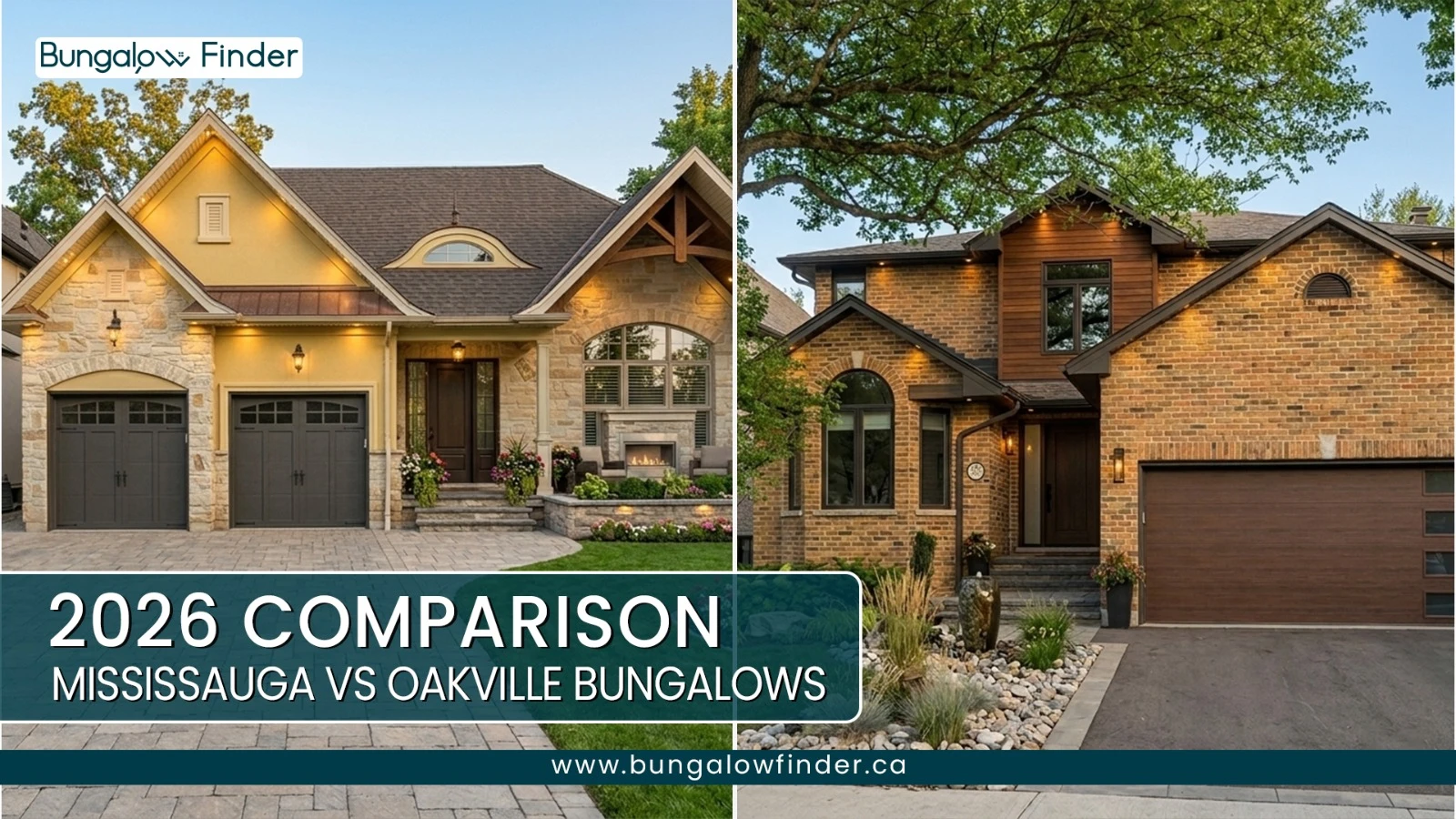
Choosing between two powerhouses? Our Mississauga vs Oakville real estate 2026 breakdown reveals which city offers the highest land value appreciation and the best lifestyle ROI for bungalow buyers this year.
Mississauga vs Oakville real estate is one of those comparisons that never really disappears from buyer conversations in the GTA. It shows up with first-time buyers, families upsizing from condos, and even long-term homeowners trying to decide where life feels more sustainable.
On paper, both cities sit next to Toronto, both are part of the wider GTA housing comparison market, and both offer established suburban Toronto homes with strong detached and bungalow options.
But once you actually spend time in both, the comparison stops feeling technical.
Mississauga feels more connected, more active, and more layered with urban-suburban energy. Oakville feels slower, more controlled, and more residential in a way that is noticeable without explanation. That difference becomes even more obvious when you focus specifically on bungalows, because at that point buyers aren’t just comparing property — they’re comparing lifestyle over time.
Why This Comparison Matters More in Today’s GTA Housing Market
The reason Mississauga vs Oakville real estate 2026 gets so much attention right now is simple: buyers are no longer just comparing square footage or price per foot.
They’re comparing how a place feels after the initial excitement wears off.
The GTA housing market has shifted heavily toward lifestyle-driven decisions, especially in suburban areas. Buyers moving away from Downtown Toronto bungalows or Midtown condos are not just upgrading space — they’re changing pace entirely.
That’s where Mississauga and Oakville sit in the same conversation but lead to very different outcomes.
Both cities offer strong access to employment zones, transit systems, and suburban infrastructure. But the way those systems blend into everyday life is not the same.
GO Transit accessibility also plays a major role in this comparison. Mississauga buyers often prioritize direct commuter flexibility into Toronto, while Oakville buyers usually place more value on residential calm once they return home.
The First Real Difference: How the Cities Move
The easiest way to understand Mississauga vs Oakville real estate is not through listings, but through driving.
Mississauga feels continuously active. Roads like Hurontario, Dundas, and areas around the Downtown Core / City Centre stay in motion almost all day. Even residential Mississauga neighbourhoods eventually connect back into commercial or commuter flow.
Oakville moves differently. The transition is more gradual, but noticeable. As you enter areas like Old Oakville or Eastlake, traffic slows, streets widen slightly, and residential consistency becomes more dominant than commercial interruption.
It’s not about one being better. It’s about how quickly your environment stops feeling “busy.”
That difference alone often becomes the deciding factor for buyers without them realizing it.
2026 Price Comparison Table: Mississauga vs Oakville Real Estate
One reason buyers keep researching Mississauga vs Oakville real estate 2026 is that pricing differences are no longer just about house size. Land value, commute convenience, taxes, and neighbourhood prestige now shape purchasing decisions just as much as the structure itself.
Factor | Mississauga | Oakville |
Average bungalow price Mississauga 2026 / Oakville | Approx. $1.15M–$1.45M | Approx. $1.45M–$2.2M+ |
Typical lot size | Moderate to large, depending on the neighbourhood | Larger lots in established south Oakville pockets |
Property tax (approx) | Slightly lower overall | Higher in premium lakefront areas |
Commute time to Toronto Union Station | Approx. 25–40 mins via GO | Approx. 35–50 mins via GO |
Price per square foot comparison | More flexible across neighbourhoods | Higher premiums are tied to land value |
Proximity to Lake Ontario | Strong in Port Credit and lakefront areas | Strong throughout South Oakville and Bronte |
Land transfer tax Ontario costs remain similar structurally in both cities, but final carrying costs usually increase faster in Oakville because of higher home values and premium neighbourhood pricing.
Why Bungalows Still Hold Strong Demand in Both Cities
Detached bungalows remain one of the most stable property types in the entire GTA housing comparison market.
The reason is structural and emotional at the same time.
Structurally, bungalows offer:
single-level living
larger land footprint compared to newer builds
easier long-term adaptability
stronger renovation or rebuild potential
Emotionally, they offer something newer suburban Toronto homes often don’t — breathing space.
Compared to inner-city or metropolitan housing, bungalows feel less compressed. Driveways matter again. Backyard space feels usable instead of symbolic. Neighbour separation feels real.
That’s why even with rising condo density and townhouse developments, bungalow demand in Mississauga vs Oakville real estate continues to stay strong.
Mississauga vs Oakville Real Estate Pricing: What Buyers Actually Experience
Pricing in this comparison is less straightforward than most expect.
Mississauga offers broader entry points. Buyers can still find older bungalow pockets, mid-range detached homes, and premium areas like Mineola West, where pricing starts overlapping with Oakville, depending on street and lot size.
Oakville behaves differently. Pricing moves upward faster, especially in established southern neighbourhoods and anywhere close to Old Oakville / Eastlake or the lakefront.
The key difference is not just price level — it’s how quickly the price becomes tied to land rather than structure.
Here’s how most buyers experience it:
Factor | Mississauga | Oakville |
Entry-level bungalow access | Wider availability | Limited |
Mid-range market | Strong and diverse | More compressed |
Luxury demand | Spread across Mississauga neighbourhoods | Concentrated and premium |
Transit influence | High commuter impact | Moderate |
Neighbourhood variation | High diversity | More consistent tone |
Long-term land value | Growth-driven | Prestige-driven |
In broader property price comparison Canada trends, Oakville consistently behaves like a long-term hold market, while Mississauga reflects a more active, commuter-influenced market.
Mineola West vs Old Oakville: Two Different Interpretations of “Residential”
This is where Mississauga vs Oakville real estate becomes easier to feel than explain.
Mineola West (Mississauga)
Mineola West is one of those Mississauga neighbourhoods that doesn’t try to stand out loudly, but consistently performs well for bungalow buyers.
The area has mature trees, wider lots, and a mix of original bungalows and newer custom homes that gradually changed the neighbourhood over time.
What makes it work is balance.
You are still close to Port Credit, GO Transit, highway access, and everyday amenities, but the internal streets remain quiet and residential. It doesn’t feel disconnected, but it doesn’t feel exposed either.
It attracts buyers who want suburban calm without giving up convenience entirely.
Old Oakville / Eastlake
Old Oakville and Eastlake operate on a different rhythm entirely.
These Oakville neighbourhoods feel more stable in identity. Streets are quieter, homes sit on larger, established lots, and the environment feels intentionally preserved rather than evolving rapidly.
Even everyday movement feels slower. Not inconvenient — just less pressured.
This is where Oakville transitions fully into lifestyle territory. Buyers are no longer asking “how close is everything,” but instead “how does it feel living here daily.”
Other Bungalow Areas Buyers Commonly Compare
Applewood usually comes up for buyers who want older bungalow streets without jumping straight into premium Mississauga pricing. It still has that older neighbourhood feel, mature trees, and decent access to schools and commuting. Applewood bungalows Mississauga tend to sit in that middle space where buyers feel like they’re getting some character without going fully upscale.
The Lorne Park vs Bronte comparison is mostly about the direction of lifestyle. Lorne Park is quieter and more upscale, with larger homes and a more private feel overall. Bronte real estate Oakville feels different — more connected to the lake, marina nearby, walkable in parts, and generally more relaxed in that waterfront way.
Glen Abbey is usually picked up by families who want structure around them — schools, parks, trails, everything feels fairly planned out. In a broader family-friendly vibe comparison talk, Glen Abbey feels more consistent and organised, while older Mississauga pockets feel less uniform, a bit more mixed depending on the street.
Lifestyle Differences That Only Show Up After Moving In
This is where Mississauga vs Oakville real estate stops being theoretical.
In Mississauga, convenience defines daily life. Everything is accessible — groceries, highways, schools, transit connections. That accessibility becomes part of routine quickly, especially for commuters.
For buyers comparing top schools in Oakville vs Mississauga, both cities perform strongly, but Oakville often attracts families specifically prioritizing long-term school rankings and quieter residential surroundings.
But the trade-off is constant activity. Even quieter areas still feel connected to larger movement patterns.
Oakville creates a different pattern. Daily life feels slower without losing functionality. Errands feel less rushed. Evenings feel quieter. Weekends feel more spaced out instead of segmented.
The difference also becomes visible in shopping and dining in Port Credit vs Downtown Oakville. Port Credit feels more energetic and socially active, while Downtown Oakville feels calmer, more curated, and less crowded overall.
Over time, buyers stop comparing features and start comparing rhythm. That’s usually where preference becomes obvious.
Investment Potential: Where Is the ROI Higher?
Investment discussions around Mississauga vs Oakville real estate 2026 usually come down to two things: rental demand versus prestige appreciation.
Mississauga benefits from stronger commuter activity, larger employment zones, transit connectivity, and higher overall rental movement. In broader discussions around rental demand in Peel vs Halton region, Peel usually sees more active tenant turnover because of access to jobs, transit corridors, and nearby educational institutions.
Oakville performs differently. Appreciation tends to be tied more closely to prestige neighbourhoods identity, limited inventory, and long-term ownership stability. In many Oakville housing market trends, South Oakville properties continue behaving more like legacy assets than short-term investment flips.
Historical appreciation rates also show an important difference between the two markets. Mississauga often experiences broader growth tied to infrastructure and future development projects Mississauga continues introducing, while Oakville’s premium areas usually appreciate through land scarcity and luxury demand.
In simple terms:
Mississauga tends to offer stronger activity-driven ROI.
Oakville tends to offer stronger prestige-driven appreciation.
Bungalow Investment Potential: Why These Properties Hold Long-Term Value
In many established neighbourhoods, especially south Mississauga and South East Oakville, bungalow lots are becoming harder to replace. That scarcity keeps long-term demand stable even during slower market periods.
Part of the appeal also comes from flexibility. Buyers can renovate, expand, rebuild, or hold the property long-term depending on future market conditions. Compared to newer suburban homes built closely together on smaller lots, older bungalows usually offer stronger redevelopment potential and more usable outdoor space.
In Mississauga, bungalow investment activity is often supported by commuter demand, transit accessibility, and rental flexibility. In Oakville, long-term value tends to be tied more closely to prestige neighbourhoods, limited inventory, and premium land appreciation near Lake Ontario.
That’s one reason bungalow buyers in the GTA often view these homes as both lifestyle purchases and long-term real estate investments at the same time.
Which City Naturally Fits in Today’s GTA Market
Mississauga tends to suit buyers who want:
strong GTA connectivity
better commuter access into Toronto
more Mississauga neighbourhoods variety
flexible price entry points
a balance between urban and suburban living
Oakville tends to suit buyers who prefer:
quieter long-term residential environments
stronger prestige-driven neighbourhood identity
larger, more consistent bungalow lots
slower lifestyle rhythm
less direct overlap with urban intensity
Both cities function well within the GTA housing comparison market. They simply serve different interpretations of suburban living.
GTA Housing Trends: Why This Debate Keeps Growing
The reason Mississauga vs Oakville real estate continues to dominate search behaviour is that both cities represent the two strongest post-Toronto housing directions.
Buyers leaving central Toronto are usually not just looking for affordability anymore. They are looking for balance — space, commute, and lifestyle stability.
Mississauga represents flexibility within reach of Toronto.
Oakville represents separation with residential consistency.
Inventory levels in GTA suburban markets have also changed buyer behaviour. Detached bungalow inventory remains tighter than many buyers expect, especially in established southern Mississauga and Oakville neighbourhoods where redevelopment pressure continues to increase land competition.
That tension is exactly why bungalow demand remains strong in both.
Final Thoughts: It’s Not Really a Property Decision
Mississauga vs Oakville real estate eventually stops being about houses and becomes about how people want to structure their daily life.
Mississauga keeps you closer to movement, access, and variety across different Mississauga neighbourhoods. Oakville reduces that movement and replaces it with quiet, stability, and a more defined residential identity across Oakville neighbourhoods.
Neither is objectively better in the GTA housing comparison market.
But they are not the same experience either.
And most buyers don’t really decide based on charts or pricing tables. They decide based on which street feels easier to imagine coming home to — and that decision usually happens long before they realize it.
FAQs
Why do people compare Mississauga vs Oakville real estate so much?
Because from a distance they look similar. Same GTA belt, similar housing types, both have strong bungalow pockets. But once you spend time in both, they don’t feel the same at all.
What’s the biggest difference between living in the two?
Mississauga feels more active, more connected to everything. Oakville feels slower and more residential. It’s not something you notice on paper, more when you’re actually driving around.
Is commuting easier from Mississauga?
Generally yes. It connects more directly to Toronto routes. Oakville is still fine, just a bit more spread out depending on the pocket.
Where do people usually look for bungalows in Mississauga?
Mineola West gets mentioned a lot. Applewood and Lorne Park are also common choices, depending on budget and lifestyle preference.
What about Oakville — where are the bungalow areas?
Old Oakville, South West Oakville, Bronte, and Glen Abbey are some of the better-known areas buyers compare regularly.
Why is Oakville more expensive in general?
A lot of it comes down to land and location. Certain areas, especially closer to the lake, have a different level of demand.
Do families lean more toward Mississauga or Oakville?
It depends on what they value. Mississauga works better for convenience and access. Oakville feels better for space, quieter streets, and long-term residential stability.