Surveys, Easements and Title When Buying an Older Ontario Bungalow
How Ontario’s land registry, easements, and a surveyor’s plan apply to an older bungalow lot, and why a fence line is not the same as the title.

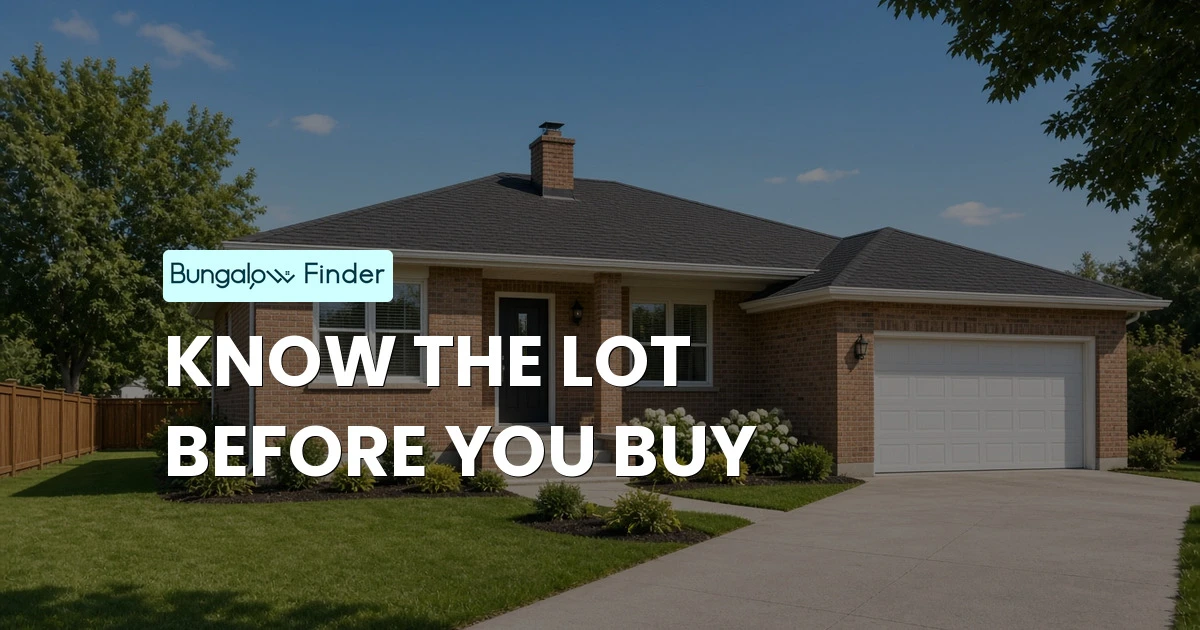
An older bungalow can look straightforward from the sidewalk: a compact house, a driveway, a fence, perhaps a garden shed. The legal lot is often less straightforward. Mid-century streets in the Greater Toronto Area, Hamilton, Niagara and similar Ontario cities were laid out with modest frontages, shared drives, utility strips, and fences that have crept over the years. What a buyer is actually purchasing is the land described on title, plus and minus the legal interests that run with it — not the lawn as it appears after a Saturday of mowing.
Ontario keeps those records in the land registration system. The official overview of the land registry states that the registry contains the official records of property ownership and other legal interests such as mortgages, transfers and leases, and that it covers more than 7.4 million parcels in the province. Searches are done online through OnLand. ServiceOntario reviews and certifies registrations, but it does not search a property for you, give legal advice, or explain the records. The same page tells the public to contact a professional such as a lawyer, a title searcher or a surveyor for help.
This walk-through is about what that means on an older bungalow lot: when a survey helps, what an easement is, and why a fence line is not a substitute for the parcel register.
The buyer’s starting point
Most bungalow listings include a lot size in the marketing comments and a photograph of the yard. Those figures can be copied from an old listing or from a seller’s memory. They are not a survey, and they are not a title search. The starting job is to find out what is registered against the parcel and how the house, the driveway, the garage and the fences sit relative to the legal boundaries.
That job matters more on older one-storey lots than many buyers expect. A bungalow with a side yard just wide enough for a car, a garage built close to the lot line, a mutual driveway, or a rear shed can be physically comfortable and still raise a title or survey question. Encroachments — a eavestrough, a step, a fence, a paved drive, or a garage overhang that crosses the boundary — are common on streets where the original houses have been altered for sixty or seventy years.
Buyers who already have a bungalow inspection booked sometimes treat the survey as an optional extra. The inspector can comment on the condition of a garage or a fence. The inspector cannot, unless also a licensed surveyor, tell you where the lot line is. A current survey is not automatically included in every resale, and Ontario law does not hand every buyer a new plan as a standard closing document. Whether you need one is a decision to make with the lawyer, based on the title, the age of any existing plan, and what you can see on the ground.
If you are comparing houses in more than one city, the legal machinery is still provincial. A bungalow in Oakville and a bungalow in Hamilton are both on the Ontario land registration system. The local quirks are in the lots themselves: the width of the frontage, the presence of a mutual drive, a utility corridor, or a historical right-of-way.
The rules that apply in Ontario
Land in Ontario is recorded in the electronic land registration system. Authorized users register documents when people buy, sell, finance or otherwise change a property. The official records of ownership and of other legal interests live there. The public search portal is OnLand. What you can usefully pull, or have a lawyer pull, includes the parcel register and the documents recorded on it: transfers, charges (mortgages), and other registered instruments.
Easements are among the interests that can appear on title. They are not a minor footnote. An easement is a legal right to use someone else’s land for a defined purpose, or a burden on land for the benefit of other land or, in some cases, for the benefit of a utility or other holder. Ontario’s land-registration bulletin on easements and the release of easements is written for registry staff and professionals, but the practical point for a buyer is simple: if an easement is on title, it runs with the land until it is properly released or otherwise dealt with. Buying the bungalow means taking the lot subject to that interest, unless the agreement and the title work say otherwise.
Typical easements on residential lots include rights for hydro, water, sewer or telecommunications services, drainage, and mutual or shared driveways. A “blanket” or poorly described right, or an easement that cuts through a rear yard where a buyer hoped to add a garage or a garden suite, can affect how the lot can be used. The text of the registered instrument, not the listing remark, is what governs.
A survey, prepared by a licensed Ontario land surveyor, is the plan that relates those legal lines to what is on the ground. The Association of Ontario Land Surveyors is the professional body for that work; AOLS is the place to confirm that a practitioner is licensed. A survey can show monuments, dimensions, the position of the house and garage, fences, eaves, driveways, and registered easements as they fall on the lot. An old survey in a kitchen drawer may still be useful as history. It may also be out of date if the house, the garage, the neighbouring fences or the legal description have changed.
Title insurance is common in Ontario resale purchases. It is a policy, with its own coverage, exclusions and conditions, and it is not a survey. It does not move a fence. It does not create a right to build over an easement. Buyers should have the lawyer explain what a particular policy would and would not do in light of the actual title and any known survey issues, rather than treating “we will get title insurance” as a substitute for reading the parcel register.
ServiceOntario’s own warning is worth repeating. Land registration records can be quite complex. The government will not interpret them for you. A lawyer’s review is part of an ordinary bungalow purchase, not an upgrade.
How this usually shows up on a bungalow
Post-war bungalow streets were often laid out with modest widths. A detached one-storey house may sit quite close to one side lot line, with a single driveway along the other side. Over time, a carport becomes a garage, a porch is enclosed, a neighbour replaces a fence a few inches over, or two households share a strip of asphalt without anyone producing a document. On closing day, those informal arrangements meet the parcel register.
Mutual driveways are a classic example. Some are formalized as easements on title. Some are only a long habit. A buyer who needs reliable access to a rear garage, or who plans to park beside a bungalow with no mutual-drive document, needs the lawyer to say which of those two situations applies.
Utility easements often run along the rear of a lot or along a side yard. They may limit fencing, decks, pools, or a garden suite even when the grass looks uninterrupted. A bungalow buyer who is buying for the lot as much as for the house — a rear addition, a workshop, a parking pad — should read those instruments before falling for the yard.
Encroachments show up in small pieces: a roof overhang over the neighbour’s land, a shed that straddles a rear line, a retaining wall, or steps that sit on a side-yard easement. None of these is automatically fatal. Each needs to be identified, and then dealt with by the lawyer, sometimes with a neighbour acknowledgement, a revised structure, or an express decision to accept the risk. Hoping that no one will notice is not a plan.
Older subdivisions can also have unfinished, missing or confusing survey fabric. A seller may have a survey from 1974 that does not show a later garage. A lot may have been subject to a reference plan that the listing never mentions. The land registry holds those plans. A surveyor can tell you whether they still describe what you are looking at.
These title and boundary issues sit beside, and should not be confused with, the physical condition of the house. A sound roof and a dry basement do not locate the lot line. A clean condition review of an older bungalow still leaves the legal lot as a separate file.
Checks that belong on the property
On the viewing, stand back and compare the house to the lot as it appears from the sidewalk and the yard. How close is the bungalow, the bay window, or the chimney to the apparent side line? Does the driveway look shared? Does a fence jog in a way that suggests it was built to a patio rather than to a survey marker? Is there a shed, a generator, a heat pump, or a deck that sits on or over a likely boundary or a rear utility strip? Note what you see, including anything that would be expensive to move.
Do not treat iron bars, neighbour folklore, or “the fence has always been there” as a survey. If markers are visible, photograph them and give the photographs to the lawyer and, if one is hired, to the surveyor. Do not move or “refresh” a marker.
Ask whether the seller has a survey, when it was prepared, and whether anything has been built since: a garage, a porch, a fence, a shed, an addition. A survey that predates those changes is incomplete for the house you are buying.
If the lot is one of the reasons you are making the offer — a future addition, a parking space, a garden structure — say so to the lawyer early. The easements and setbacks that allow or limit that work will not be obvious from a listing photograph. Municipal zoning and setback rules are a separate layer from title; both have to work together, and neither should be inferred from the fact that a neighbour has already built something similar.
A surveyor, when one is retained, should be a licensed Ontario land surveyor. The scope should be written: a full up-to-date survey, a surveyor’s real property report, or a more limited opinion, depending on what the title and the lot require. That scope is a professional decision.
Documents worth requesting
Ask for any existing survey or sketch, the parcel identification, and any documents the seller has about a shared driveway, a fence agreement, or a neighbour arrangement. Then have the lawyer obtain the current parcel register and the instruments that actually matter, including easements, rights-of-way, restrictive covenants, and outstanding charges.
If a prior title-insurance policy exists, it can be useful history. It is not, on its own, a current survey or a current title opinion for this purchase.
Building permits for a garage, a deck or an addition help explain whether the structure you see was at least reviewed by the municipality. They do not locate the lot line, and a permit is not a guarantee that the structure sits entirely on the lot.
Where a mutual drive or a shared cost for a private lane is part of daily life, ask for the written arrangement and confirm whether it is on title. A handshake between two previous owners does not automatically bind the next ones.
Closing funds should also be thought through in the ordinary way, including land transfer tax. The site’s land transfer tax calculator can help a buyer estimate the provincial tax; it does not replace the lawyer’s figures, and it is not a survey cost or a title-insurance premium. Those amounts have to come from the professionals on the file.
Points that are often misread
“The listing gives the lot size, so we know the boundaries.” Marketing figures are not a legal plan. The parcel register and, where needed, a surveyor’s work are what describe the land.
“The fence is the lot line.” Sometimes it is close. Sometimes it is not. Fences are often built for convenience, by a contractor without a survey, or in a location that both neighbours once found agreeable. Only a survey, read against title, answers the question.
“Title insurance means we do not need a survey.” Title insurance may be an appropriate part of the file. It does not stake the corners, and it will not let you keep a structure that sits on a neighbour’s land simply because a policy was issued. Coverage depends on the policy and on what was known or disclosed. That is a question for the lawyer.
“An easement is only a problem if we can see a path.” Many utility easements are invisible on a tidy lawn. The restriction is in the registered document, and it can affect a fence, a pool, a deck or a future addition.
“A 40-year-old survey is as good as a new one.” It is a historical record. If the house or the neighbouring occupation has changed, or if you need current measurements for a building project, the lawyer and a surveyor should say whether it still answers the question.
“ServiceOntario can just tell us what the title means.” The official land-registry overview is direct: the government does not search, advise, or explain a property’s records. A lawyer, a title searcher or a surveyor does that work.
Questions that come up on viewings
Is there a survey, what is its date, and has anything been built or any fence moved since it was prepared?
Does the driveway, a walkway, or a garage appear to be shared, and is there a registered easement or a written agreement?
Are there rear or side utility easements, and would they interfere with a fence, a shed, a parking pad or a later addition?
Do any eaves, steps, retaining walls or outbuildings appear to sit on or over a likely lot line?
Who is the lawyer on the purchase, and when will the parcel register and the easement documents be reviewed relative to the condition period?
Those questions belong in the same conversation as the roof, the heating system and the foundation. A tidy yard can hide a messy legal lot; a slightly awkward yard can sit on a perfectly clean title. The documents are how you tell the difference.
A note before you go further
Buying an older bungalow is a purchase of land, not only of a one-storey house. The land registry is the official record, OnLand is how it is searched, and a lawyer is the person to interpret it. A licensed surveyor is the person to relate that record to the fences and eaves you can see. Title insurance can be part of the protection on the file; it is not a plan of survey.
If you are walking through houses now, take photographs of the drive, the fences and any structure near a boundary, and put those photographs in front of the lawyer early. Current bungalows listed for sale still have to be read against their parcels, one lot at a time. The official advice from Ontario is consistent: when the records are complex, involve a professional who is qualified to explain them.