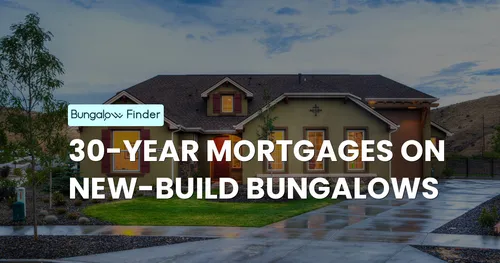
30-Year Mortgage on a New Bungalow in Canada: 2026–2027 Rules and Costs
30-year insured mortgage on a new bungalow in Canada: who qualifies, the $1.5M cap, CMHC surcharge, down payment and interest costs for 2026–2027.
A first-time buyer looking at a newly built bungalow often hears two conflicting stories about the 30-year mortgage. One says the longer amortization is still just a proposal. The other says every bungalow purchase, new or resale, now qualifies automatically. Neither matches the federal rules actually in force.
If you are planning a purchase in late 2026 or in 2027, this guide covers what is available today, how it differs for a new-build bungalow versus a resale, what the 30-year option really adds to your insurance premium and interest, and which questions to settle with your lender before you write an offer.
A Lower Payment Is Only Half the Story
Stretching to 30 years can cut the monthly payment on a $900,000 new bungalow by roughly $400, as the worked example later in this guide shows. The same choice adds an insurance surcharge and about $130,000 in lifetime interest. Whether it is the smart move depends on who you are and what you are buying, because the rules differ sharply between a new build and a resale.
Quick Answer
Yes, 30-year insured amortization is already available. It has been in force since 2024.
Who qualifies: first-time buyers (new or resale) and any buyer of a new build, when the down payment is under 20%.
Price cap: the purchase price must be under $1.5 million for the mortgage to be insured.
Extra cost: a 0.20% surcharge on the CMHC premium applies to amortizations beyond 25 years, plus more total interest.
Repeat buyer on a resale: still limited to 25 years on an insured mortgage.
30-Year Mortgage on a New Build: The Rules in Force
The 30-year insured amortization arrived in two stages.
Timeline of the Rule
Date | Change | Who Was Eligible |
|---|---|---|
August 1, 2024 | 30-year insured amortization introduced | First-time buyers of newly built homes |
December 15, 2024 | Eligibility expanded; insured price cap raised from $1 million to $1.5 million | All first-time buyers (new or resale) and all buyers of new builds |
What the FCAC Says Today
The Financial Consumer Agency of Canada states the consumer rule plainly. If your down payment is less than 20% of the home's price, your maximum amortization is:
30 years if you are a first-time buyer, if you are buying a new build, or both
25 years in all other insured cases
If your down payment is 20% or more, your lender sets the maximum amortization period.
The $1.5 Million Insured Price Cap
Before December 2024 the cap for insured mortgages was $1 million, a limit dating back to 2012. It is now $1.5 million. A buyer who needs mortgage insurance (down payment under 20%) cannot insure a purchase at or above that threshold, and the 30-year option does not create a way around it. This matters for bungalows in higher-priced GTA markets.
Amortization vs. Term
The 30 years is the amortization, the long clock used to calculate your payments. It is not the mortgage term, which is the length of your current contract (often five years or less). You will renew several times, and the remaining amortization will be part of each renewal conversation.
Do the 30-Year Rules Still Apply in 2027?
As of November 2026, the federal rules described in this guide remain in force, and the original Finance Canada announcement set no end date for them. A buyer closing in 2027 is therefore working under the same framework, but lender policies, insurer guidelines and your own approval can differ from one file to the next.
Because eligibility is decided when the insurance application is submitted, confirm these points again when you have an accepted offer, not only when you start browsing:
The insurer's current amortization and price-cap rules
Whether your lender offers 30 years on your specific product
Your buyer status and the home's new-build classification on the date of application
Who Can Use a 30-Year Amortization?
Eligibility at a Glance
Buyer Type | Property Type | Insured Mortgage (Under 20% Down) | 20%+ Down |
|---|---|---|---|
First-time buyer | New build | 30 years | Lender sets maximum |
First-time buyer | Resale | 30 years | Lender sets maximum |
Repeat buyer | New build | 30 years | Lender sets maximum |
Repeat buyer | Resale | 25 years | Lender sets maximum |
The only insured category still limited to 25 years is a repeat buyer purchasing a resale home.
The Official Definitions
The Department of Finance Canada sets out the official definitions of a first-time buyer and a new build. In summary:
A first-time homebuyer is a borrower who meets one of these:
Has never purchased a home before
Has not, in the last four years, lived in a home they or their spouse or common-law partner owned as a principal residence
Has recently experienced the breakdown of a marriage or common-law partnership
A new build is a home that has not previously been occupied for residential purposes. The definition is not meant to exclude newly built condominiums that had an interim occupancy period.
Owner-Occupancy Still Applies
Government-backed mortgage insurance remains available only where the borrower, or a spouse, common-law partner, child or parent of the borrower, occupies one of the housing units on the property. A 30-year insured amortization is not a tool for a pure investment purchase.
What a Longer Amortization Does and Does Not Do
It can lower your monthly payment, which is why the change was introduced.
It does not make the home cheaper.
It stretches repayment and increases the total interest you pay if you stay on the longer clock.
New-Build Bungalow Financing vs. Resale
New-build and resale financing overlap more than they did in mid-2024, but they are not identical.
Newly Built Bungalow
A buyer who needs mortgage insurance may be able to use 30 years whether or not they are a first-time buyer, subject to the price cap and lender and insurer approval. That can make a new bungalow easier to qualify for than a similarly priced resale if you are a repeat buyer with less than 20% down.
Resale Bungalow
The 30-year insured amortization is available to first-time buyers who otherwise qualify. A repeat buyer putting down less than 20% is generally held to 25 years.
If You Have 20% or More Down
The federal insured-amortization rule no longer sets your maximum. Your lender does. Some lenders offer 30 years on uninsured loans and some do not. That is a lender product decision, not a government entitlement, so get it in writing for the bungalow you are actually buying.
New-Construction Process Points
New construction also comes with its own mechanics: occupancy dates, holdbacks, and sometimes a different insurance application timeline than a resale. These are separate from the amortization rule, but raise them with your lender and lawyer early.
What 30 Years Really Costs: Premium, Tax and Interest
The monthly payment is only part of the picture. A 30-year amortization changes three costs: the insurance premium, the provincial sales tax on that premium, and the lifetime interest.
The CMHC Premium and the 30-Year Surcharge
CMHC's published premium schedule for owner-occupied homes sets the premium by loan-to-value (LTV) ratio:
Loan-to-Value Ratio | Standard Premium | With 30-Year Surcharge (+0.20%) |
|---|---|---|
Up to 65% | 0.60% | 0.80% |
65.01% to 75% | 1.70% | 1.90% |
75.01% to 80% | 2.40% | 2.60% |
80.01% to 85% | 2.80% | 3.00% |
85.01% to 90% | 3.10% | 3.30% |
90.01% to 95% | 4.00% | 4.20% |
CMHC states that an amortization period beyond 25 years is subject to a 0.20% surcharge. The premium is a one-time charge that can be added to your mortgage balance. Ontario charges 8% Retail Sales Tax on the premium, and that tax cannot be added to the loan, so it is paid in cash at closing.
Worked Example: A $900,000 New Bungalow With 10% Down
Assumptions: $90,000 down, an $810,000 loan (90% LTV), an illustrative 4.5% rate, and monthly payments with semi-annual compounding.
25-Year Amortization | 30-Year Amortization | |
|---|---|---|
Premium rate | 3.10% | 3.30% |
Premium added to loan | $25,110 | $26,730 |
Total mortgage with premium | $835,110 | $836,730 |
Monthly payment | about $4,622 | about $4,219 |
Total interest over full amortization | about $551,500 | about $682,100 |
Ontario sales tax on premium (8%, paid in cash) | about $2,009 | about $2,138 |
In this scenario the 30-year option saves roughly $400 a month, adds about $1,620 to the premium, and adds roughly $130,000 in lifetime interest if you never prepay or shorten the amortization. Your numbers will differ with your rate and down payment, so run your own price through the lender's calculator.
The FCAC's Interest Example
The FCAC is direct about the trade-off: a longer amortization lowers regular payments but means you pay more interest, potentially thousands or tens of thousands of dollars. Its published example uses a $300,000 mortgage at 4%.
Amortization | Monthly Payment | Total Interest | Source |
|---|---|---|---|
20 years | $1,813 | $135,057 | FCAC example |
25 years | $1,578 | $173,418 | FCAC example |
30 years | $1,427 | $213,560 | Calculated using the same method* |
*The FCAC's published examples stop at 25 years. The 30-year line applies the same calculation (semi-annual compounding, monthly payments) to show the pattern continuing.
A New-Build Advantage Worth Asking About
CMHC's Eco Products offer a 25% partial premium refund when you purchase or build an energy-efficient home or make energy-efficient improvements. Many new bungalows are built to higher efficiency standards, so ask your lender whether yours qualifies.
Ways to Cut the Extra Interest Later
Increase your regular payments
Make prepayments, if your contract allows them
Shorten the amortization at renewal
Plan for these. Do not assume them.
Minimum Down Payment on a Bungalow Under the $1.5 Million Cap
The minimum down payment is 5% of the first $500,000 of the price plus 10% of the portion between $500,000 and $1.5 million. Homes priced at $1.5 million or more require at least 20% down on the full price and cannot be insured.
Purchase Price | Minimum Down Payment |
|---|---|
$600,000 | $35,000 |
$900,000 | $65,000 |
$1,200,000 | $95,000 |
$1,499,999 (highest insurable price) | about $125,000 |
$1,500,000 or more | 20% of the full price ($300,000 or more) |
Approval Is Not Automatic
Eligibility for 30 years is not approval. You still have to meet the lender's and insurer's underwriting, including the mortgage stress test. For insured mortgages, lenders test your payments at the greater of your contract rate plus 2% or 5.25%. A longer amortization can lower the payment used in that test and may ease qualification, but it does not replace a full approval.
Buyers putting down as little as 5% are the ones most affected, because insurance is required whenever the down payment is under 20%.
Questions to Ask Before You Write an Offer
Ask your lender or mortgage broker to put the following in writing for the specific address:
Will the mortgage be insured, and by which insurer?
Is the bungalow classified as a new build or a resale?
Are you treated as a first-time homebuyer under the insurer's official definition?
Do the purchase price and lending value sit under the $1.5 million insured cap?
What amortization is used to qualify you, and what appears in the commitment?
Is the 0.20% surcharge included in your premium quote?
What are the term and rate type, and what happens to the remaining amortization at renewal?
If you are comparing a new and a resale bungalow, run both through this list. A repeat buyer can be eligible for 30 years on the new one and limited to 25 on the resale, even at similar prices. Proposals such as the Budget 2026 mortgage insurance changes are not a substitute for the 30-year rule already in force.
How to Compare a 25-Year and 30-Year Offer
Ask for a side-by-side on the same rate and term, if both are available to you. Compare:
The monthly payment
The premium and the sales tax on it
The interest paid over the first term
The balance you would still owe at renewal
If only the 30-year version lets you qualify, be honest with yourself about that. Approval-day affordability and year-three comfort are different tests. A payment that works only because it was stretched leaves less room for property taxes, heating, maintenance and the extras that often appear after closing on a new home.
If you can qualify on 25 years comfortably, that is usually cheaper over the life of the loan. If you need 30 years to buy a new bungalow you can otherwise carry, go in with a plan to accelerate payments later.
Final Thoughts
For a first-time buyer, or any buyer of a new build, the 30-year insured amortization is a real option under current federal rules, and those rules carry into 2027 purchases. It is not a rumour and not a blank cheque. Confirm how your lender classifies the home and your buyer status, stay inside the $1.5 million cap if you need insurance, and weigh the extra premium and interest against the lower monthly payment before you commit.
FAQs
Is a 30-year insured mortgage available in Canada now?
Yes. It was introduced on August 1, 2024 for first-time buyers of new builds and expanded on December 15, 2024 to all first-time buyers and all buyers of new builds. It is in force, not a proposal.
Does the 30-year rule still apply in 2027?
As of November 2026 the rules remain in force and the official announcement gave no end date. Eligibility is decided when the insurance application is submitted, so confirm the current rules with your lender once you have an accepted offer.
Can I get a 30-year mortgage on a resale bungalow?
Yes, if you are a first-time buyer, the mortgage is insured and the price is within the insured cap. A repeat buyer with less than 20% down on a resale is generally limited to 25 years. With 20% or more down, your lender sets the maximum.
Do I have to be a first-time buyer for a new bungalow?
No. If the bungalow is a new build and the mortgage is insured, the 30-year option is open to all buyers, subject to the cap and the lender's and insurer's approval.
Who counts as a first-time buyer?
Under the Finance Canada criteria, a borrower who has never purchased a home, who has not lived in a home they or their spouse or partner owned in the last four years, or who recently went through the breakdown of a marriage or common-law partnership.
What counts as a new build?
A home that has not previously been occupied for residential purposes. Newly built condominiums with an interim occupancy period are not meant to be excluded.
What is the insured mortgage price cap?
$1.5 million, effective December 15, 2024. At $1.5 million or more, a high-ratio insured mortgage is not available, so the federal 30-year insured rule would not be the product you use.
Does a 30-year amortization cost more in CMHC insurance?
Yes. CMHC applies a 0.20% surcharge to the premium for amortizations beyond 25 years. For example, the 90.01% to 95% LTV tier moves from 4.00% to 4.20%.
Is 30 years the mortgage term?
No. It is the amortization. The term is the length of your current contract, often five years or less, after which you renew.
Does a 30-year amortization cost more interest?
Yes, if you stay on the longer schedule. The FCAC notes that a longer amortization can add thousands or tens of thousands of dollars in interest. Compare 25-year and 30-year illustrations for your own mortgage.
Does a 30-year amortization guarantee approval?
No. You still need to pass the lender's and insurer's underwriting, including the stress test.
Is this the same as the Budget 2026 mortgage insurance proposals?
No. The 30-year insured amortization is already in force. Budget proposals are a separate topic and should be treated as proposals until implemented.