Lead Water Service Pipes in Older Ontario Bungalows
Lead water pipes in older Ontario bungalows: Health Canada and Ontario limits, who owns which part of the service, and what buyers should check first.
Many of the bungalows that line older streets in Toronto, Hamilton, and other Ontario cities were built in the decades after the Second World War. They often have good bones: a full basement, a solid brick shell, a lot wider than a newer subdivision would offer. Some also still have the original water service pipe, the line that carries drinking water from the street into the basement. On a house of that age, that pipe may be made of lead.
Lead is not something a buyer can see from the front walk, and it is rarely mentioned in a listing. The water itself leaves the treatment plant without lead. The City of Toronto states that water produced at its treatment plants does not contain lead, and that lead enters drinking water as lead service pipes, older solder, and leaded-brass fixtures corrode and break down (City of Toronto, Lead and Drinking Water). The question for a buyer is what sits between the water main and the kitchen tap.
This piece covers how lead service pipes show up in older bungalows, which official standards apply in Ontario, and what to check and ask for before you commit. It draws on Health Canada, Ontario’s drinking-water regulation, and the City of Toronto and City of Hamilton.
Why The Service Pipe Belongs On The Condition List
A buyer usually learns about the plumbing from three sources: the seller’s answers, the home inspector’s report, and whatever renovation history the listing mentions. None of them is a lab result. A seller may honestly not know what the service pipe is made of. An inspector can look at the pipe where it enters the basement but cannot see the section buried under the lawn or the street. A note that the house was “updated” may refer to copper inside the basement while the line from the property line to the meter stays original.
Age is the first clue. Toronto says houses built before the mid-1950s may have a lead water service pipe. Hamilton puts the line at 1955 and estimates that about 20,000 homes in that city built before then may have a lead service connecting them to the municipal supply (City of Hamilton, Lead Water Service Replacement). A bungalow from the late 1940s or early 1950s falls squarely inside that window.
The Drinking-Water Rules That Apply In Ontario
Health Canada’s Guideline
Health Canada’s guideline technical document on lead, published 8 March 2019, sets a maximum acceptable concentration for total lead in drinking water of 0.005 mg/L (5 micrograms per litre), based on a sample taken at the tap. It adds that current science cannot identify a level below which lead is no longer associated with adverse health effects, so concentrations should be kept as low as reasonably achievable.
Ontario’s Regulated Standard
Ontario’s legally prescribed standard is set in Ontario Regulation 169/03, the Ontario Drinking Water Quality Standards under the Safe Drinking Water Act, 2002. Schedule 2 lists lead at 0.010 mg/L. On the e-Laws currency date shown when this piece was prepared (10 November 2026), the consolidated regulation’s last amendment was O. Reg. 457/16, so the provincial standard remained at twice the federal guideline value.
Reference | Lead value | What it is |
|---|---|---|
Health Canada guideline (2019) | 0.005 mg/L | National guideline, measured at the tap |
Ontario Regulation 169/03, Schedule 2 | 0.010 mg/L | Ontario’s prescribed drinking water quality standard |
Those numbers matter if you receive a lab result. They do not change the practical advice from Ontario municipalities, which is to reduce exposure and, where a lead service exists, plan to replace it.
Who Owns Which Part Of The Pipe
Toronto and Hamilton both split the service line at the property line. Toronto explains that the City owns the part from the water main on the street to the property line, and that the part from the property line into the home is private property and the homeowner’s responsibility. Hamilton states the same division: maintenance, repair or replacement of the portion on private property is the homeowner’s exclusive responsibility, and Hamilton Water handles the portion on City property.
That split shapes every repair conversation. A buyer can replace the private side, but the full benefit depends on the municipal side being replaced too.
How Lead Services Usually Show Up In A Bungalow
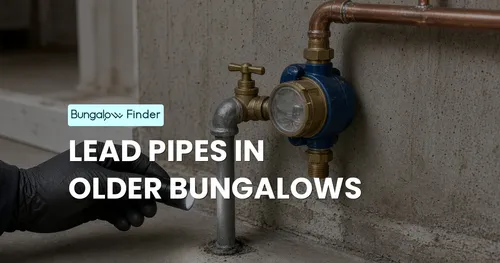
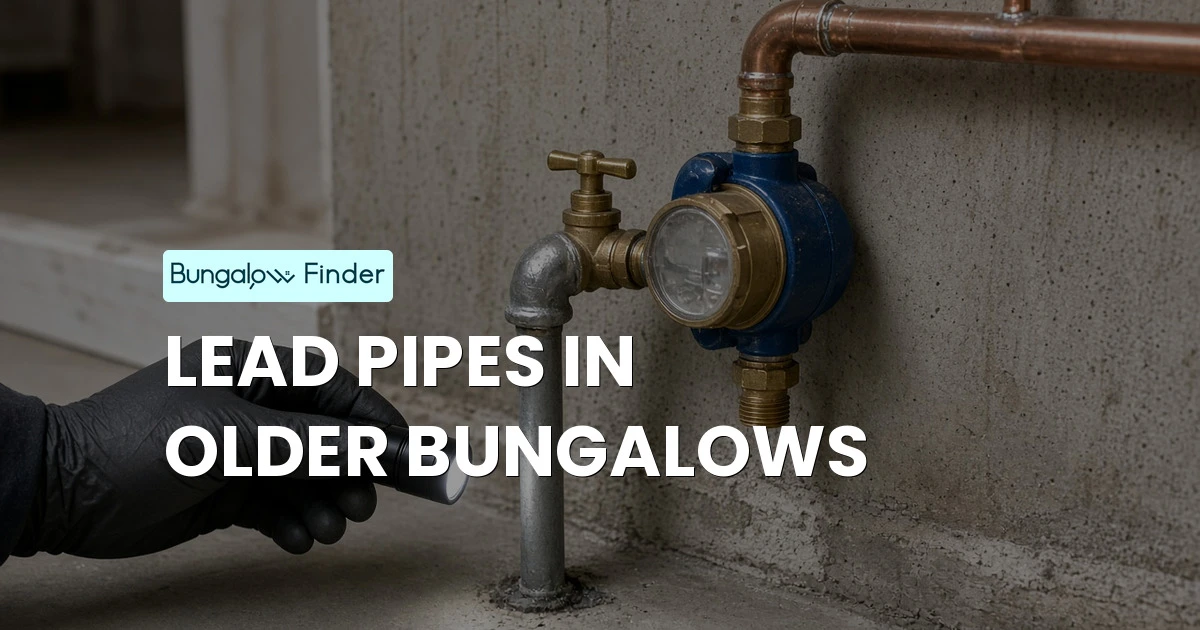
In a bungalow with a basement, the service pipe typically enters at basement level and runs to a shut-off valve and the water meter. That makes the pipe easy to find and, in most cases, easy for an inspector or plumber to examine.
Toronto describes a simple first look: if the pipe that goes into the water meter is grey, scratches easily, and does not sound hollow when you tap it, it may be lead. It also lists other sources of lead in older homes, including solder used to join pipes before 1990 and leaded-brass fixtures such as faucets and valves. A bungalow can have new copper throughout the basement and still be fed by an original lead line from the street.
Toronto also notes that apartment and other buildings with more than six units do not have lead water service pipes, regardless of age, because lead is too soft for the pressure those buildings need. The risk sits with houses and small buildings, which is where most bungalows fall.
Partial Replacement Is A Known Problem
Both cities warn against replacing only one side. Toronto Public Health strongly recommends replacing your side of the pipe at the same time as the City replaces its side, because cutting the pipe to replace one portion can release lead particles and cause a temporary spike in lead levels. Hamilton’s program is built the same way: when an owner replaces the private portion of a lead service, the City replaces the public portion.
Corrosion Control Is Not A Replacement
Both cities add phosphate to drinking water as corrosion control. Toronto began in 2014 and says ongoing regulated test results show lower lead levels than before treatment. Hamilton started its corrosion control program in November 2018 and notes that it takes time for the protective barrier to build up across its system. Neither city presents corrosion control as a reason to keep a lead service; both describe replacing it as the permanent fix.
What To Check At The Meter And In The Records
Look at the service pipe at the meter. Note its colour and whether a plumber or inspector believes it is lead. Ask the inspector to photograph it.
Ask a licensed plumber when in doubt. Toronto says a licensed plumber can determine whether a service pipe is lead, usually by inspecting the pipe near the meter.
Check the municipality’s records. In Toronto, a 311 service request asks staff to check City records, which the City says can take up to 30 business days. In Hamilton, the City offers a free Check Size and Type Inspection of the water service line on request at 905-546-2489.
Test the water. Toronto says testing is the only way to know if your water has lead, and offers free lead testing through Toronto Water’s accredited labs. Other municipalities and public health units have their own options; ask before you buy a private kit.
Look past the meter. Older solder and leaded-brass fixtures are also possible sources, so a lab result reflects the whole plumbing path.
Price the private side. Ask a licensed contractor to quote replacement of the private portion from the property line to the house, including restoration of the lawn, walk, or driveway.
Documents Worth Requesting On The Service Pipe
Document | Why it matters |
|---|---|
Any plumbing invoice or permit for a water service replacement | Shows whether the private side was replaced, when, and with what material |
Correspondence with the municipality about the City-side pipe | Confirms whether the public portion has already been replaced |
Lab results for lead, if the seller has tested | Gives a dated reading, though conditions can change |
The home inspection report with photographs of the service pipe | Records what was visible at the meter |
Details of any municipal loan attached to the property | In Hamilton, a lead replacement loan is repaid through the water bill |
That last point deserves care in Hamilton. The City offers a $3,000 interest-bearing loan for owners replacing a lead water line, with the loan and interest added to the monthly water bill for a maximum ten-year repayment period. Owners who qualify for low-income energy support programs such as LEAP or OESP are eligible for a zero-interest loan. If a seller used that program, your lawyer should confirm how any remaining balance is handled on closing.
In Toronto, residents who commit to replacing the private portion can apply to have the City replace its side through the Priority Lead Water Service Replacement Program. The City also replaces City-owned substandard pipes during planned road, sewer and watermain work through its Capital Water Service Replacement Program.
Points That Are Often Misread About Lead Pipes
“The city water is safe, so the house is fine.” Toronto, for example, states that water from its treatment plants does not contain lead. Lead enters from the service pipe, solder, and fixtures between the main and the tap.
“New copper in the basement means no lead.” Updated interior plumbing can still be fed by an original lead service from the street.
“Boiling will take care of it.” Hamilton states plainly that boiling tap water does not remove lead, and both cities advise against using hot tap water for drinking or cooking.
“The inspector would have flagged it.” A visual inspection at the meter is useful, but it is not a lab test, and it cannot see the buried section.
“Replacing my side solves it.” Partial replacement can cause a temporary spike in lead levels. The strongest approach is coordinated replacement of both sides.
“Every older house has lead.” Not every pre-1955 bungalow has a lead service; many have been replaced over the years. Age raises the question; records, inspection and testing answer it.
A Note Before You Go Further
A lead service pipe is one of the quieter items on an older-bungalow condition list, next to the wiring, the roof and the foundation that our notes on hidden problems in older bungalows cover. It deserves a specific line in the bungalow inspection and a question for the seller, and the answer should be in writing. If you are browsing bungalows listed for sale in older neighbourhoods, add the build year to your shortlist so the question comes up early, not on the last day of the condition period.
A word on scope: the points above summarise Health Canada, Government of Ontario, City of Toronto and City of Hamilton, and they are not medical, plumbing or legal advice. Programs, eligibility and loan terms change; confirm them with the municipality, and speak with a public health professional about health questions.
FAQ
Do Older Bungalows In Ontario Have Lead Water Pipes?
Some do. Toronto says homes built before the mid-1950s may have a lead water service pipe, and Hamilton estimates about 20,000 homes in that city built before 1955 may have one. Many have since been replaced, so the pipe at the meter, municipal records, and a water test are the way to know.
What Is The Safe Limit For Lead In Ontario Water?
Health Canada’s guideline sets a maximum acceptable concentration of 0.005 mg/L for total lead at the tap and advises keeping levels as low as reasonably achievable. Ontario Regulation 169/03 lists a provincial standard of 0.010 mg/L.
How Can I Tell If The Service Pipe Is Lead?
Toronto says a pipe going into the water meter may be lead if it is grey, scratches easily, and does not sound hollow when tapped. A licensed plumber can confirm it, and some cities, including Hamilton, offer a free inspection of the service line.
Who Pays To Replace A Lead Water Service?
The homeowner is responsible for the private portion, from the property line into the house. The municipality is responsible for the portion from the water main to the property line. Toronto and Hamilton both coordinate City-side replacement when the owner replaces the private side.
What Should I Do With The Water Until Replacement?
Toronto and Hamilton both advise running the cold tap for at least five minutes when water has been sitting and using cold water for drinking and cooking. Toronto also suggests a filter certified to NSF-053 for lead removal, and Hamilton adds that boiling does not remove lead.
Is A Lead Pipe A Reason To Walk Away From A Bungalow?
Not on its own. It is a known, fixable item with a cost, and in some cities, a municipal program to help. Build the replacement into your budget and negotiation, and confirm the facts during the condition period.