Downsizing to a Bungalow Ontario: The Ultimate 2026 Retirement Guide
Downsizing to a bungalow Ontario is the smartest 2026 move for retirees. Unlock your home equity and discover the best age-in-place single-level layouts.
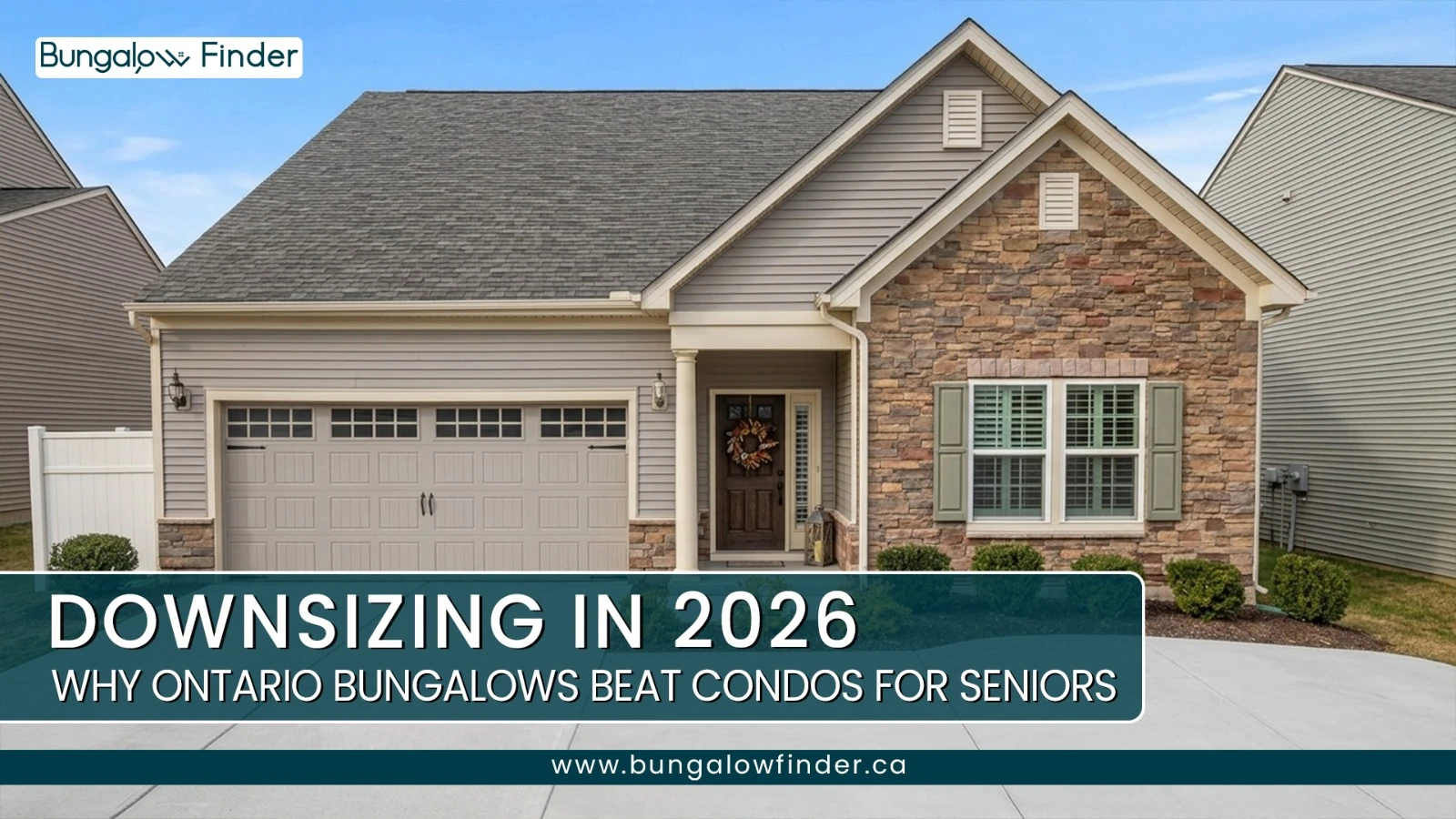
Say goodbye to stairs and hello to freedom; downsizing to a bungalow Ontario offers retirees a mix of accessibility, financial flexibility, and long-term housing stability in a market that keeps shifting under familiar routines.
Across Ontario, housing choices are changing in quieter ways. Long-time homeowners are starting to look at space differently. Maintenance feels heavier than it used to, and multi-storey homes don’t always sit as comfortably in daily life anymore.
In this shift, downsizing to a bungalow Ontario is becoming part of retirement planning in a more natural way — shaped by mobility, lifestyle changes, and how home equity eventually gets used.
This guide takes a closer look at how that shift is unfolding across Ontario and what it means for homeowners thinking about their next move.
A Demographic Shift That’s Reshaping Housing Choices
Ontario’s housing story is closely tied to its ageing population. Roughly one in five residents is now over 65, and that number continues to rise.
Most homes across the province weren’t built with that reality in mind. The standard two-storey detached house reflects a different stage of life — one built around families, movement, and physical ease rather than long-term mobility.
As people age, the home starts to feel different in small but constant ways. Stairs stop being background detail and become part of decision-making. Basements get used less. Movement through the house becomes more segmented than it once was.
That’s where Senior living Ontario bungalows start to make more sense. A single-level layout removes those barriers entirely, not as a lifestyle upgrade, but as a practical response to how daily life actually changes.
The Financial Turning Point Behind Downsizing
For many homeowners nearing retirement, housing becomes less about space and more about structure — especially financial structure.
Over the past two decades, home values across regions like the GTA, Niagara, and Simcoe County have climbed steadily. CMHC data continues to show that for older Canadians, a large portion of household wealth sits inside their primary residence.
The challenge is access. That value exists on paper, but not in day-to-day use.
This is where equity release strategies come into play. Moving from a larger home into a bungalow allows homeowners to convert locked-in property value into usable financial flexibility.
That shift can support retirement income, reduce pressure on monthly spending, or help with healthcare and lifestyle costs. At the same time, downsizing to a bungalow Ontario often brings quieter financial relief — lower utilities, reduced maintenance, and more predictable ongoing costs compared to larger homes.
It’s not just a change in size. It’s a change in how wealth is actually used.
When Staying Put Starts Costing More Than Moving On
Timing tends to matter more than people expect.
Many homeowners wait until maintenance becomes harder or health begins to change, but by then, options can already feel narrower. Selling a well-maintained home earlier often means better positioning in the market and a wider pool of buyers, which can influence overall equity outcomes.
On the other side, buying a bungalow in Ontario has its own timing pressure. Supply isn’t unlimited, especially in areas where demand for single-storey homes stays consistent.
That’s why some people start the transition while they still feel fully independent. Not because they have to — but because it keeps more choices open.
In practice, timing affects both sides of the decision: lifestyle comfort and financial outcome through equity release strategies.
Comparing Housing Reality in Simple Terms
Factor | Multi-Storey Home | Bungalow |
Daily physical effort | Higher due to stairs and levels | Lower and more consistent |
Maintenance load | Spread across multiple systems | More contained and simpler |
Long-term mobility | Can become limiting | Supports aging in place |
Monthly costs | Generally higher | Typically lower |
Home equity access | Locked into property | Easier to unlock through sale |
Long-term suitability | Often declines with age | Remains stable or improves |
This comparison often sits at the centre of the bungalow vs condo for seniors decision that many homeowners eventually face.
Why Bungalows Feel Easier in Practice
A bungalow is simple in structure, but that simplicity shows up most clearly in how people live inside it.
Everything sits on one level — bedrooms, kitchen, bathroom, living spaces — all connected without stairs shaping the movement of the day.
That’s why no-stairs floor plans have become more common in retirement-focused housing across Ontario.
The impact isn’t loud. It builds gradually.
Less effort moving between rooms.
Less thinking about movement.
Less physical interruption in daily routines.
And over time, less strain is tied to ordinary tasks.
Designing for the Long Run: Accessibility That Matters
Housing design in Ontario is slowly adjusting to longer, more independent living later in life.
That’s where accessibility features for seniors are becoming more standard, not as upgrades but as expectations.
Step-free entries, wider hallways, walk-in showers, lever handles, and non-slip flooring all fit into this shift. These features connect directly to age-in-place home design — the idea that people should be able to stay in their homes longer without needing major changes later on.
Bungalows already align with that thinking because they remove the biggest barrier from the start: stairs.
What Changes When Your Home Works on One Floor
Beyond physical access, there’s a quieter shift in how daily life feels.
Without stairs or split levels, the home becomes more continuous. Movement doesn’t require planning. Tasks don’t require sequencing around floors.
Things like cooking, cleaning, or simply moving from one room to another start to feel more direct. For many retirees, that matters less as a dramatic change and more as a steady reduction in friction.
Over time, the home stops feeling like something you navigate and starts feeling like something that simply fits around your routine.
The Often-Ignored Cost of Maintenance
One of the more practical reasons people look at downsizing to a bungalow Ontario is maintenance pressure.
Ontario’s climate adds a constant layer of stress to homes — freeze-thaw cycles, snow, humidity shifts, seasonal wear.
In larger homes, that maintenance spreads across more surfaces and systems. Roofs, basements, heating, cooling, exterior upkeep — all of it continues regardless of how much of the house is actually used.
This is where maintenance-free living becomes more of a concept than a reality. No home removes maintenance entirely, but bungalows reduce complexity, which makes upkeep easier to manage over time.
Bungalow vs Condo for Seniors: Two Different Housing Paths
Condos and bungalows often get compared, but they solve different problems.
Condos offer shared maintenance, amenities, and reduced day-to-day responsibility. In exchange, they come with monthly fees and shared governance through condo boards.
Bungalows offer full ownership — land, structure, and control. That means more privacy and more freedom in how the space is used or changed.
For many considering downsizing to a bungalow Ontario, that independence often outweighs convenience alone.
Where Retirees Are Choosing to Live in Ontario
The retirement movement across Ontario tends to concentrate in a few familiar regions.
Niagara Region, Simcoe County, Southwestern Ontario, Eastern Ontario, and the outer areas of the GTA continue to attract downsizing buyers.
These areas offer a balance that many retirees look for — affordability, access to healthcare, and day-to-day livability that feels less intense than major urban cores.
Within these regions, Senior living Ontario bungalows remain consistently in demand, especially in some of the best retirement towns in Ontario, where lifestyle balance plays a major role in housing decisions.
The Emotional Layer Most People Don’t Talk About
Housing transitions are not only financial decisions. They are also tied to familiarity and long-term personal history.
For many homeowners, a house represents decades of routines, milestones, and family life. That emotional connection naturally slows decision-making. However, over time, the functional demands of maintaining a larger home often begin to outweigh its familiarity.
At that point, downsizing to a bungalow Ontario tends to shift from an emotional decision to a practical one.
The Bigger Picture Behind Downsizing
Across Ontario, the same pattern keeps showing up: ageing population, rising home equity, and changing expectations around how homes function later in life.
Senior living Ontario bungalows, no-stairs floor plans, accessibility features for seniors, equity release strategies, and age-in-place home design all sit within the same broader shift.
It’s not a trend in isolation. It’s a slow restructuring of what housing needs to support.
Closing Thought
Downsizing isn’t really about space. It’s about pressure — the kind that builds quietly over time.
Homes either evolve with life or slowly fall out of sync with it. A bungalow tends to stay aligned simply by removing the friction that accumulates in larger spaces.
For many homeowners in Ontario, downsizing to a bungalow Ontario isn’t about leaving something behind. It’s about stepping into something that feels easier to live in without thinking about it too much.
As more people begin to rethink long-term living, bungalows remain one of the most practical directions in Ontario’s housing landscape. Exploring available options on Bungalow Finder can be a simple way to see what that shift actually looks like today.
FAQs
1. Why are retirees in Ontario moving toward bungalows?
Mostly because stairs start becoming a daily hassle, and people just want less to deal with at home as they get older. A bungalow removes that layer completely.
2. Does downsizing to a bungalow in Ontario actually help financially?
It can. A lot of the time it frees up equity tied in the home, and monthly costs usually drop too — especially upkeep and utilities.
3. What makes a bungalow different from a condo for seniors?
A bungalow is still a full house — land, privacy, control. Condos are easier day-to-day, but you give up some independence and deal with shared rules and fees.
4. Are bungalows really easier to live in long term?
Yes, mainly because everything is on one floor. No stairs, no split levels — just simpler movement through the space.
5. Where do retirees usually look for bungalows in Ontario?
Niagara comes up a lot, same with Simcoe County and quieter parts of Southwestern Ontario. Some GTA edges too, depending on budget.