The Real Cost of Buying a House in Ontario: Hidden Expenses Guide
What is the actual cost of buying a house in Ontario? Learn about closing costs, property taxes, and hidden bungalow maintenance fees in 2026.
Buying a home in Ontario already feels like a big financial step, but when it comes to bungalows, the real cost often goes far beyond the listing price. On paper, it might look manageable—down payment, mortgage, done. In reality, the total cost of buying a house in Ontario includes layers of expenses that many buyers only fully understand after closing.
Understanding the hidden costs of buying a bungalow is not just helpful—it’s necessary if you want a clear picture of affordability in today’s Ontario housing market.
The Real Cost of Buying a House in Ontario Starts Before You Move In
When people think about the cost of buying a house Ontario, they usually focus on the purchase price and mortgage approval. But the actual financial picture starts much earlier.
Before you even step into the home, there are upfront expenses that shape your budget. These are commonly grouped under closing costs in Canada, and they apply whether you’re buying a condo, townhouse, or detached bungalow.
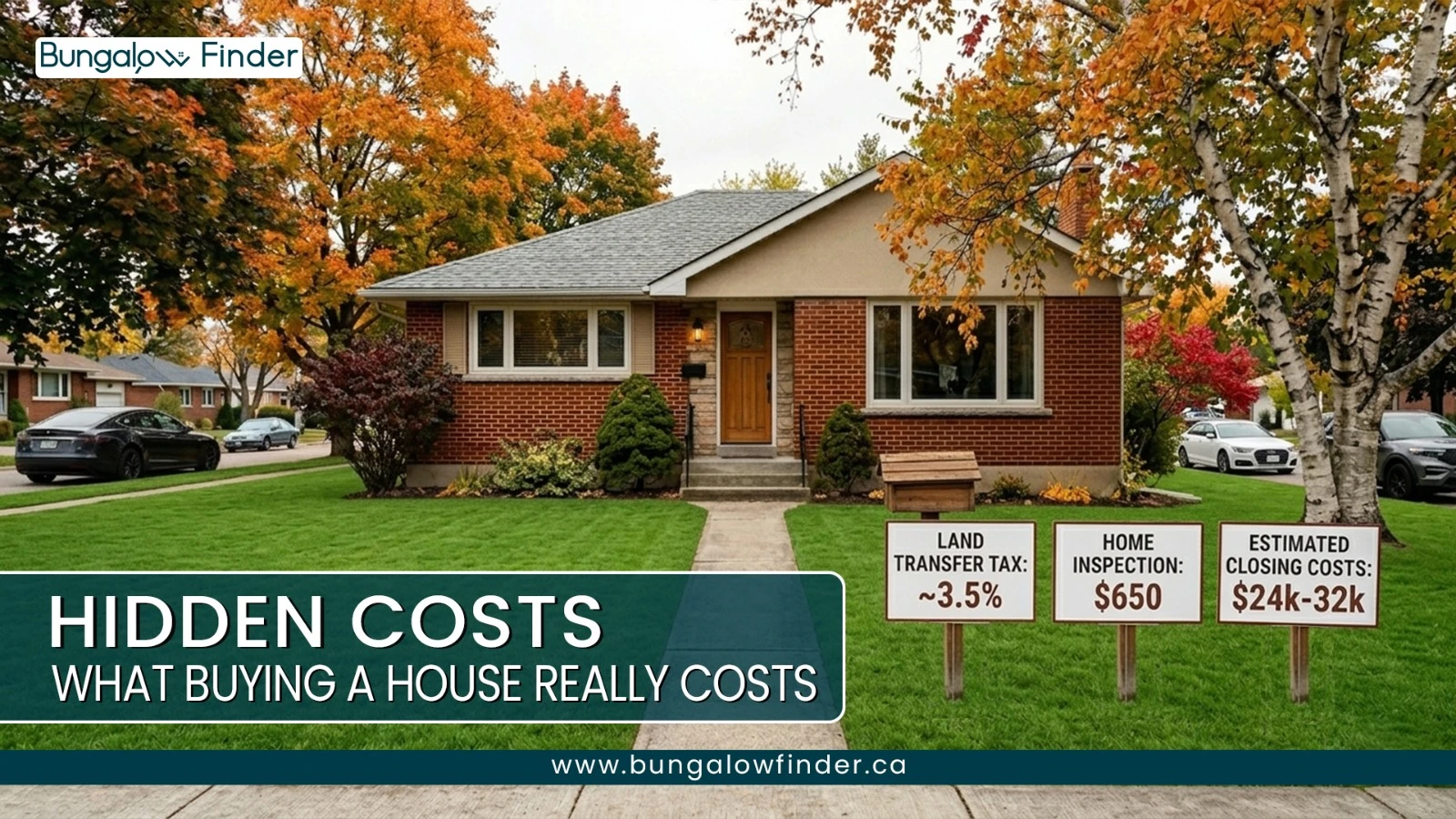
In Ontario, closing costs in Ontario typically range from 3% to 4% of the purchase price, on a $800,000 bungalow, which can easily mean $24,000 to $32,000 in additional expenses.
And this is just the starting layer.
Closing Costs in Ontario: What You’re Actually Paying For
The phrase closing costs Canada gets used a lot, but many buyers don’t break it down properly. In Ontario, these costs are made up of several components that can vary depending on the property.
You’re typically paying for:
Land transfer tax (provincial, and sometimes municipal in cities like Toronto)
Legal fees for title transfer and documentation
Title insurance
Mortgage insurance or lender fees (if applicable)
Home inspection costs
Adjustments for utilities, taxes, or condo/land fees
Registration fees and administrative charges
The land transfer tax alone follows a progressive structure based on property value, and in Toronto, a second municipal tax doubles the impact. This is one of the biggest early shocks for buyers moving into detached homes.
So when people talk about closing costs Ontario, it’s not a single fee—it’s a bundled financial hit that arrives all at once before you even unpack.
Why Bungalows Often Cost More Than They Look
At first glance, a bungalow feels simple—one floor. Easier maintenance. No stairs. But in Ontario’s real estate market, bungalows are often older homes sitting on larger lots, and that changes everything.
The hidden costs of buying a bungalow come from what the property doesn’t immediately show.
Many bungalows in Ontario were built between the 1950s and 1980s. That means even if the house looks renovated on the surface, the core systems—plumbing, wiring, insulation, roofing—may still be outdated.
This is where home maintenance costs start to matter more than expected.
Unlike newer builds, older bungalows often require immediate or near-future upgrades, sometimes within the first year of ownership. And these are not small expenses.
Property Tax Ontario: The Ongoing Cost Buyers Underestimate
One of the most overlooked parts of affordability is the property tax Ontario.
Property taxes vary significantly depending on the city. In the GTA, rates generally fall between roughly 0.6% and 0.8% of assessed property value annually. That might sound small, but on a high-value detached bungalow, it adds up quickly.
For example, a $900,000 home can easily carry annual taxes of several thousand dollars, depending on the municipality.
The issue is not just the amount—it’s the consistency. Property tax Ontario is not a one-time cost. It’s a permanent annual expense that grows with reassessments over time.
Many buyers focus heavily on mortgage affordability and underestimate how much ongoing municipal taxes affect long-term budgeting.
Home Maintenance Costs: The Real Long-Term Expense
Home maintenance costs are often the biggest surprise for bungalow owners. Unlike condos, there’s no condo board or shared upkeep fund—everything is fully on the homeowner. Uncover the best cost per square for this stunning Ontario bungalow, offering exceptional value through spacious layouts, modern finishes, and strong long-term investment potential in a highly desirable location.
In many Ontario bungalows, especially older ones, this becomes even more noticeable because age and structure bring constant upkeep needs. Common expenses include roof repairs or full replacement, basement waterproofing, furnace or HVAC upgrades, electrical safety updates, window replacements for efficiency, driveway and exterior maintenance, landscaping and tree care, and occasional plumbing issues in older systems.
Individually, these costs may feel manageable, but together they create a steady financial burden over time. In Ontario’s climate—hot summers, freezing winters, and constant freeze-thaw cycles—wear and tear happens faster, which means maintenance is not occasional, it’s ongoing.
Real Estate Fees Ontario Buyers Don’t Always Factor In
When people calculate affordability, real estate fees Ontario are often ignored because buyers assume they are only paid by sellers.
While that is partially true, buyers still indirectly absorb costs related to real estate transactions. For example, commission structures are typically built into the final sale price of homes.
In addition to that, buyers also pay for:
Legal representation
Inspection services
Appraisal fees (in some mortgage cases)
Adjustments and administrative costs during closing
Even though these may not be labeled as “real estate fees Ontario” directly, they are part of the transactional ecosystem that affects the final cost of purchasing a home.
So while you don’t hand over a commission cheque as a buyer, the pricing structure of the market already includes it.
The Renovation Factor Most Buyers Underestimate
Bungalows often attract buyers because of their potential. Open layouts, finished basements, and renovation flexibility are major selling points.
But renovation costs in Ontario are not what they used to be.
Material prices and contractor demand have pushed costs higher across the province. Even basic upgrades can become expensive quickly.
A kitchen renovation alone can range from moderate to very high, depending on finishes. Basement finishing is another major expense, especially in older homes where waterproofing or insulation upgrades are needed first.
This is why many buyers underestimate the real financial gap between purchase price and livable condition.
Why Closing Costs in Canada Hit Harder on Detached Homes
Across Canada, closing costs in Canada remain relatively consistent in structure, but detached homes—especially bungalows—tend to push buyers toward the higher end of the range.
This is because:
Higher purchase prices increase tax calculations
Older homes require more inspection depth.
Legal complexity is higher in resale detached properties.
Insurance requirements can be stricter
So while the framework is the same, the outcome is not.
Detached bungalow buyers in Ontario often experience a more expensive closing phase simply due to property type and age.
The True Financial Picture of Buying a Bungalow in Ontario
When you combine everything together—the purchase price, closing costs in Ontario, property tax Ontario, ongoing home maintenance costs, and real estate fees Ontario—you start to see the full financial picture.
The mortgage is only one part of ownership. The rest is layered across upfront and long-term obligations that shape your actual affordability.
A bungalow might seem like a simpler lifestyle choice, and in many ways it is. But financially, it demands more awareness than most buyers initially expect.
Final Thought: What Smart Buyers Do Differently
The biggest difference between stressed buyers and prepared buyers is not income—it is planning.
Smart buyers don’t just calculate the mortgage. They calculate the full cost of buying a house in Ontario, including everything from closing costs Canada to long-term home maintenance costs.
They also factor in renovation potential, tax variations, and the reality that older detached homes carry hidden financial weight.vBecause once you understand the full picture, the decision becomes clearer—not easier, but clearer.
And clarity is what prevents regret in Ontario’s competitive housing market.
FAQs
What are the hidden costs of buying a bungalow in Ontario?
Mostly things like closing costs, land transfer tax, legal fees, inspections, property taxes, insurance, and ongoing maintenance after you move in.
How much are closing costs in Ontario?
They usually come to about 3% to 4% of the purchase price once you add up taxes, legal fees, and other required charges.
What do closing costs in Canada include?
They typically include land transfer tax, lawyer fees, title insurance, home inspection costs, and a few administrative or lender-related charges.
How much is property tax in Ontario?
It depends on the city, but most areas in Ontario are roughly around 0.6% to 0.8% of the home’s assessed value per year.
Are bungalows expensive to maintain?
They can be, especially older ones, since everything from repairs to upgrades is fully the homeowner’s responsibility.
What maintenance costs come with a bungalow?
Common ones include roofing, plumbing, heating or cooling systems, basement repairs, window upgrades, and general outdoor upkeep.