The Secondary Market Migration: Best Ontario Bungalow Hubs Beyond the GTA (2026)
Explore the best secondary markets for bungalows Ontario 2026. Discover how cities like Hamilton, Oshawa, and London offer massive land-value upside.

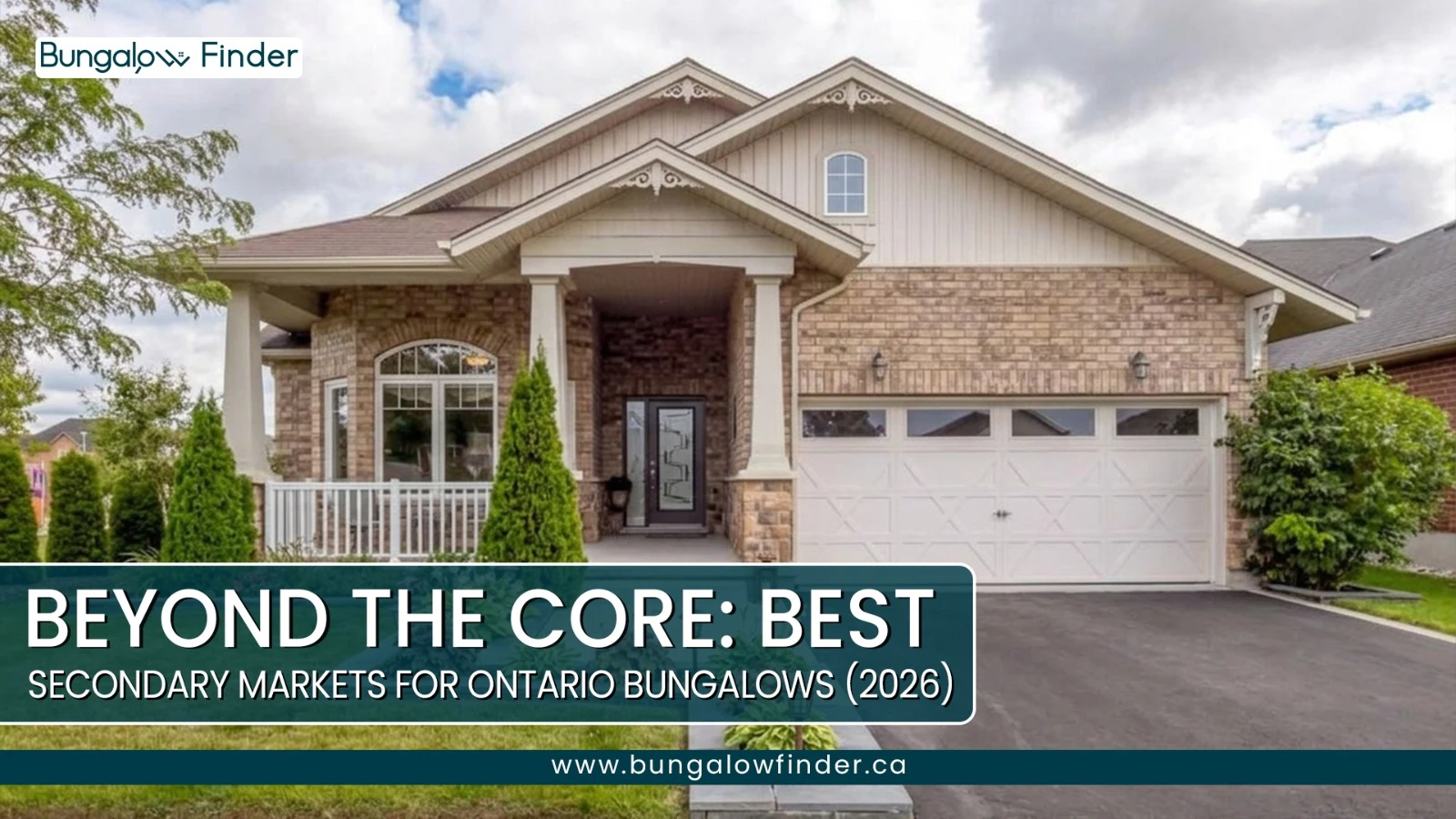
As the GTA core remains priced out, the best secondary markets for bungalows Ontario 2026, places like Hamilton, Oshawa, and London, are giving savvy investors and first-time buyers an entry point with real land-value upside. Mississauga and Oakville have crossed into territory where a detached home routinely starts above $1.2 million. For a lot of buyers, that number isn't a stretch goal anymore. It's a wall.
So the migration started. Not a dramatic exodus, more like water finding the cracks in a foundation. Buyers who'd normally fight for a semi in Streetsville are now looking at full bungalows on quarter-acre lots an hour down the highway.
What is "affordability migration" and why is it reshaping Ontario real estate in 2026?
Affordability migration is the steady outward push of buyers from Toronto's inner ring (Mississauga, Oakville, Vaughan) toward cities where a similar budget buys a detached home instead of a townhouse. It's driven by two things: GTA core pricing, and the fact that hybrid work made the commute math survivable.
The numbers tell the story. Mississauga's detached benchmark price sat at $1,272,000 in early 2026, down 9.2% from the previous year but still firmly in seven-figure territory, according to CREA-affiliated market data. Oakville is worse: the average listing price across all property types reached $1,739,100 in June 2026, with detached homes averaging $2.40 million.
Compare that to Hamilton, where the overall average home price was $777,612 in April 2026. Or London, where it was closer to $620,000. Same province, completely different math.
Hybrid work is the part that makes this sustainable rather than a one-time panic move. A buyer who needs to be in a Toronto office 2 days a week can live in Hamilton, Oshawa, or even St. Catharines and still make it work. Five years ago, that commute would've been a dealbreaker. Now it's Tuesday and Thursday.
How big is the 2026 price gap between GTA core bungalows and secondary market bungalows?
The gap runs roughly 25% to nearly 40% below the GTA average, depending on the city and the segment. London and Niagara sit at the wide end. Hamilton, Oshawa, and Kitchener-Waterloo land somewhere in the middle.
Here's the actual math. The GTA average home price was $1,017,796 in March 2026. Hamilton's average came in at $777,612 (about 24% lower). London's average was $618,665 (about 39% lower). Niagara's benchmark price was $573,700 (about 44% lower than the GTA average, though its overall average sits closer to $700,000 once you blend in higher-end detached sales).
That gap is the entire thesis behind secondary market rental demand GTA investors have been chasing. A bungalow that costs 30% less to buy doesn't usually rent for 30% less, especially in cities with a university, a college, or a large employer anchoring local demand. The rent stays close to GTA-adjacent levels while the purchase price drops. That's where the yield comes from.
It's not a guaranteed formula. Vacancy rates, property taxes, and local rent control rules vary by city, and you need to run your own numbers before assuming a high-yield bungalow investment Canada strategy will pencil out on any specific property. But the structural gap is real, and it's the reason realtors in these cities have been busy.
Where are the best secondary markets for bungalows in Ontario in 2026?
Six cities keep coming up in this conversation, and each one has a slightly different reason for being there.
Hamilton: the McMaster effect, plus an LRT that's finally happening
Bungalows for sale in Hamilton sit in a sweet spot: close enough to the GTA for a real commute, far enough away that prices corrected hard (Hamilton's average home price dropped 8.6% year-over-year as of March 2026, per WOWA's tracking of TRREB and Cornerstone Association data).
Detached average: Around $859,000 as of April 2026, with the broader market benchmark closer to $744,000.
Why it matters: McMaster University and Mohawk College anchor a deep, stable rental pool. Add the LRT (Light Rail Transit) project connecting east-west Hamilton, and you've got infrastructure spending that historically pushes land values up along the corridor.
Bungalow angle: Older Hamilton bungalows on the Mountain and in the lower city sit on lots big enough for a legal basement apartment, which is a meaningful rental income boost in a city with one of Ontario's tighter vacancy rates.
Oshawa: GO transit, Ontario Tech, and a city that's done betting on one industry
Oshawa real estate trends 2026 point to a market that's still correcting (down roughly 7% year-over-year as of March 2026) but holding up better than the headline numbers suggest, because the underlying demand drivers haven't gone anywhere.
Bungalow range: Lakeview, Oshawa's established lakefront neighbourhood, has affordable detached and bungalow stock priced from $600,000 to $850,000.
Why it matters: Oshawa GO Station puts downtown Toronto within reach without a car, and Ontario Tech University plus Durham College generate steady student and staff rental demand, particularly around the Windfields area.
The diversification story: General Motors of Canada still operates a major assembly plant here, but the local economy has broadened into tech and public sector employment, which makes Oshawa less of a one-industry bet than it was a decade ago.
Kitchener-Waterloo: betting on the tech corridor, even when it wobbles
Investing in Kitchener-Waterloo bungalows means betting on a regional economy built around two major universities and a tech sector that's had a rough couple of years, but hasn't disappeared.
Price range: The Waterloo Region's aggregate home price was $698,800 in Q1 2026 (down 5.9% year-over-year), with single-family detached homes carrying a median of $807,000, according to Royal LePage's quarterly survey.
Why it matters: University of Waterloo and Wilfrid Laurier University drive year-round rental demand, and the tech sector (despite some high-profile relocations out of the region) still anchors thousands of jobs.
Bungalow angle: Older bungalow neighbourhoods like Victoria Hills in Kitchener have shown long-term appreciation. A home that sold for $245,000 in 2015 is now listing above $550,000, more than doubling in a decade even with the recent correction.
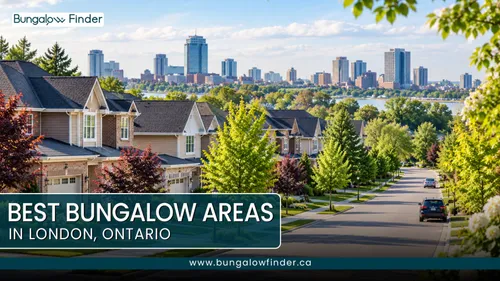
London: Ontario's lowest entry point among the six
If your budget is the limiting factor, London Ontario housing forecast data makes a strong case for being the answer. It's the most affordable city on this list by a wide margin.
Price range: The average sale price was $627,112 in March 2026, with the MLS HPI benchmark sitting at $567,400, and first-time buyers gravitating toward smaller detached homes and bungalows priced between $400,000 and $550,000.
Why it matters: Western University and Fanshawe College create a large, renewing rental pool, and London's market is dominated by end-users rather than investors, which historically means less volatility.
2026 outlook: REMAX's 2026 forecast pegs London as a buyer's market with prices expected to stay roughly flat and sales up modestly. That's not exciting, but "boring and stable" is exactly what a first bungalow purchase should be.
Niagara: tourism, wine country, and a genuine lifestyle draw
Niagara bungalow investment isn't purely a numbers game. Part of the appeal is that people actually want to live there, which supports both resale demand and a short-term rental angle that doesn't exist in most of the cities on this list.
Price range: The regional benchmark was $573,700 in April 2026 (down 6.3% year-over-year), with detached benchmarks closer to $656,400 in higher-demand pockets.
Why it matters: Brock University and Niagara College support traditional rental demand, while the tourism economy (wineries, Niagara Falls, the Welland Canal corridor) supports a secondary short-term rental market in towns like Niagara-on-the-Lake.
The caveat: Conditions vary wildly by sub-market. St. Catharines is sitting close to balanced, while Niagara-on-the-Lake is in a deep buyer's market where prices may have further to fall before they stabilize.
Milton: the GTA's last expansion frontier, not really a discount play
Milton real estate expansion is a different animal from the other five cities on this list. It's technically part of the GTA, and its average price (around $950,000 in March 2026) doesn't represent a steep discount.
Why it's still on this list: Milton sits at the intersection of Highway 401, Highway 407, and Highway 403, with its own GO Transit line. New subdivisions in neighbourhoods like Harrison, Willmott, and Ford are still being built out, which means new-build bungalows and detached homes with modern layouts.
The land-value argument: Milton is significantly cheaper than neighbouring Oakville and Burlington while sitting in the same growth corridor. Buyers priced out of those two cities are landing in Milton instead, which is the same affordability migration pattern playing out one ring closer to Toronto.
Honest framing: This is less "affordable entry point" and more "the last stop before you're paying Oakville prices." Treat it as a growth bet, not a bargain.
How do these six markets compare side by side?
City | Avg. bungalow/detached price range (2026 est.) | Primary investment driver |
|---|---|---|
Hamilton | $650,000 – $900,000 | McMaster/Mohawk rental demand, LRT corridor, GO transit |
Oshawa | $550,000 – $850,000 | Ontario Tech/Durham College, GO Train, economic diversification |
Kitchener-Waterloo | $600,000 – $850,000 | Tech sector + dual universities, long-term appreciation track record |
London | $450,000 – $700,000 | Lowest entry price, Western/Fanshawe rental pool, end-user stability |
Niagara | $500,000 – $750,000 | Brock/Niagara College, tourism economy, lifestyle migration |
Milton | $850,000 – $1,050,000 | GTA growth corridor, new-build supply, 401/407/GO access |
These are estimated ranges based on early-to-mid 2026 average and benchmark pricing across property types. Always confirm current listings and HPI benchmarks for the specific neighbourhood you're targeting. Prices inside a single city can swing by hundreds of thousands of dollars between a bungalow on a 30-foot lot and one on a 60-foot lot two streets over.
What's the long-term land-value upside of buying a bungalow over a condo or townhouse?
Bungalow land-value upside Ontario comes down to one thing: the lot is doing most of the work, not the structure on top of it. A bungalow built in 1965 on a 50-foot lot in Hamilton or Oshawa has the same land underneath it as a $1.5 million rebuild three streets away.
That creates a few specific paths that condos and townhomes simply don't have:
Garden suites and laneway housing. Several Ontario municipalities, including Hamilton and parts of the GTA, have loosened rules around secondary units on detached lots. A bungalow with a deep backyard can potentially add a second rental unit without touching the main house.
Basement apartment conversions. Bungalows tend to have full, walk-out, or above-grade basements, which are far easier and cheaper to convert into legal rental units than the basements under a two-storey home with a finished lower level already.
Future severance or redevelopment. Older bungalow neighbourhoods in secondary cities often sit on lots that were platted before modern minimum-lot-size rules tightened. As these cities densify (and most of the six on this list have stated intentions to), some of these lots become candidates for severance or low-rise infill down the road.
Renovation headroom. A dated but structurally sound bungalow purchased below the area average leaves room in the budget for a kitchen and bathroom refresh, the kind of work that closes the gap to comparable renovated homes and captures equity quickly.
None of this is a sure thing, and municipal zoning changes take years and political will to actually materialize. But the optionality that comes with land is the core reason bungalows in growing secondary cities tend to outperform condos in the same cities over a 10-year horizon. You're not just buying a place to live. You're buying a piece of dirt with multiple future uses.
FAQs
Will a bungalow in a secondary market actually hold its resale value?
History says yes, with caveats. Kitchener's Victoria Hills neighbourhood saw a detached home go from $245,000 in 2015 to over $550,000 a decade later, more than doubling even after the 2025-2026 correction. The catch is timing: anyone who bought at the 2022 peak in any of these cities is currently underwater on paper. Resale value over a 10-year hold has been strong across Southern Ontario; resale value over a 2-year hold depends entirely on when you bought.
What rental yields can I realistically expect from a bungalow in Hamilton or Oshawa?
It depends heavily on whether the bungalow has a legal secondary unit. A single-family bungalow renting as one unit in Hamilton or Oshawa typically generates a gross yield in the 3% to 4.5% range at 2026 purchase prices, similar to most of Southern Ontario. Add a legal basement apartment and that can climb meaningfully, sometimes into the 5% to 6% range, because you're collecting two rents against one mortgage. Always confirm a basement unit is legally registered before counting on that income; an illegal unit can't be used to qualify for financing and creates liability if something goes wrong.
Is Niagara more of an investment or a lifestyle purchase?
Both, but the split depends on where in Niagara you buy. St. Catharines is closer to a traditional investment market: balanced conditions, university and college rental demand, prices near the regional benchmark of $573,700 as of April 2026. Niagara-on-the-Lake is much more of a lifestyle and short-term rental play, with prices that have further room to soften according to recent market reports. If you want rental stability, look toward St. Catharines or Niagara Falls. If you want a property you'll also enjoy using, NOTL's tourism economy supports that, just go in knowing it's a different risk profile.
How far from Toronto is too far for a reasonable commute?
For 2 to 3 days a week in-office, anywhere with a direct GO Train line is workable, which covers Hamilton, Oshawa, Milton, and parts of Kitchener-Waterloo. London and most of Niagara (outside St. Catharines, which has limited GO service) are realistically 5-day-a-week remote or fully relocated buyer territory. The honest framing: if your job requires daily in-office presence, London is a relocation, not a commute extension.
Should first-time buyers consider Milton, or is it already too expensive?
Milton works best for first-time buyers who were already priced out of Oakville and Burlington and need to stay within that specific corridor for family, job, or school reasons. At an average price near $950,000, it's not an affordability play compared to Hamilton or Oshawa. But compared to its immediate neighbours, it's the relative bargain, and new-build supply means more inventory in the $850,000 to $950,000 range than you'll find in older, built-out cities. If your priority is the lowest possible entry price, Milton isn't the answer. If your priority is staying in the western GTA growth corridor while paying less than Oakville, it is.