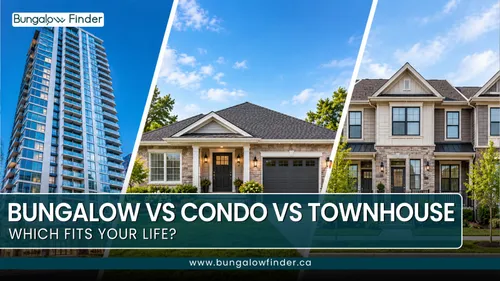
Bungalow vs Condo vs Townhouse in Ontario: Which Is Right for You?
Bungalow, condo or townhouse in Ontario? Compare prices, monthly fees, mortgage rules, risks and the best choice for your budget and lifestyle.
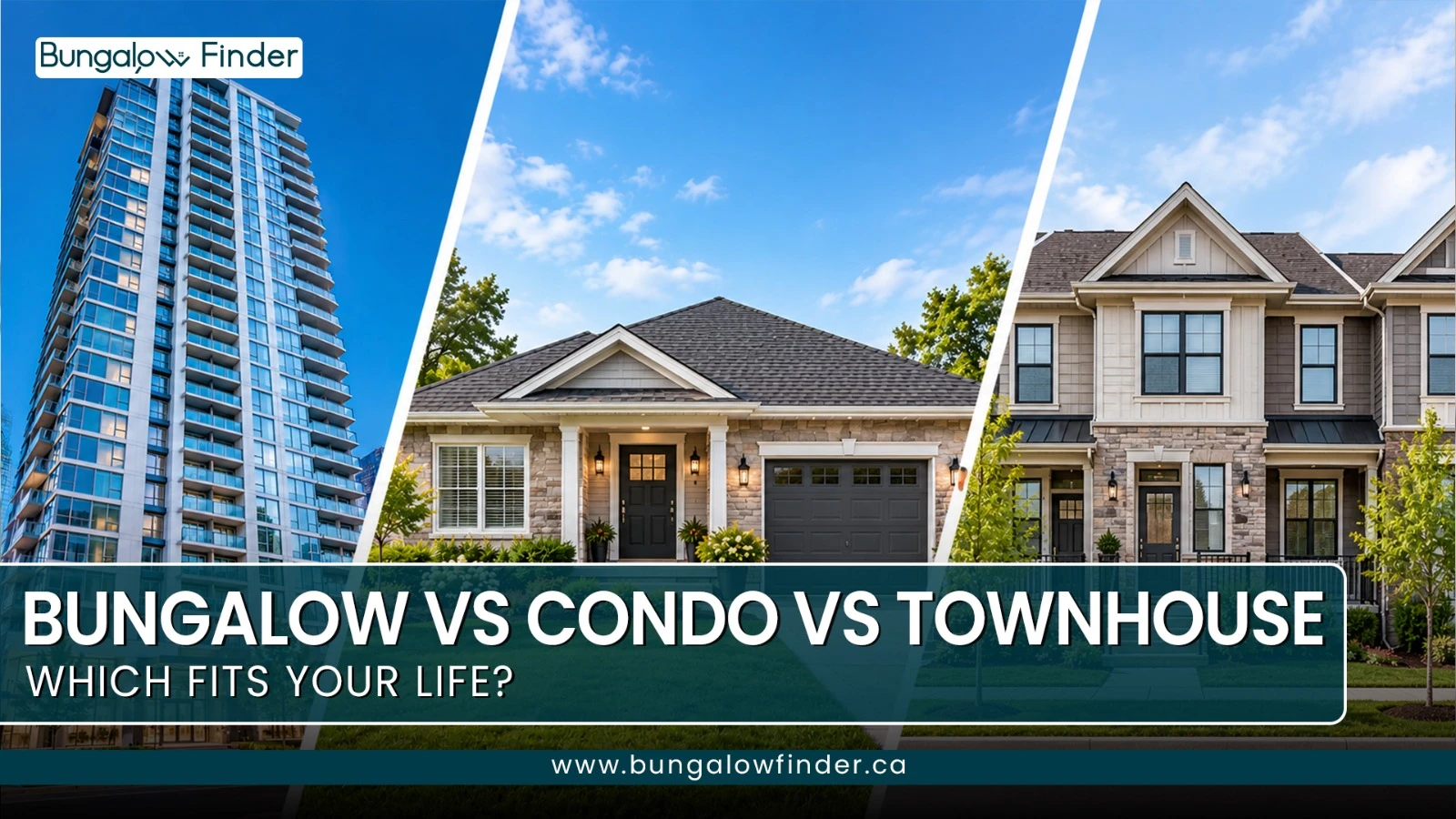
Choosing between a bungalow, a condo and a townhouse is one of the biggest decisions an Ontario buyer will make. The three home types differ in price, monthly costs, mortgage rules, maintenance, privacy and long-term value. This guide compares them side by side, with the bungalow perspective first, so you can decide which one fits your budget and your stage of life.
All figures are in Canadian dollars and are based on recent 2026 data from sources such as TRREB, CMHC and the Canada Revenue Agency. Where reliable numbers were not available, we say so. Treat all ranges as planning estimates and confirm details with a licensed professional.
The Short Answer
Feature | Bungalow | Condo Apartment | Townhouse |
|---|---|---|---|
Layout | Single level, detached | Single level inside a building | Multi-level, shared side walls |
Land ownership | Yes | No | Yes if freehold or POTL, no if condo townhouse |
Monthly fees | None (usually) | Condo fees | None (freehold) to moderate |
Maintenance | Owner does everything | Condo corporation | Owner (freehold) or shared (condo) |
Privacy and noise | Highest | Lowest | Moderate |
Long-term appreciation | Historically strongest | Slowest | In between |
Best for | Seniors, families, land value | First-time buyers, low maintenance | Families wanting space on a budget |
What Each Home Type Means in Ontario
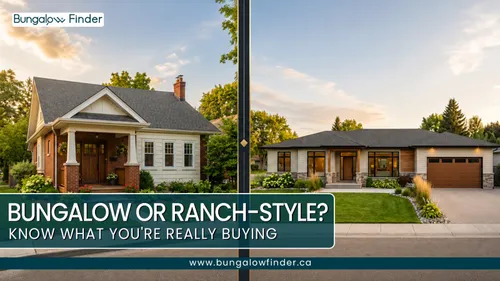
Bungalow: A home where the main living space, including the kitchen, bedrooms and laundry, sits on one level, with or without a basement. Most Ontario bungalows are detached.
Condo: A legal ownership structure where you own your unit's interior and share ownership and costs of common elements, like hallways, amenities and grounds, with other owners through a condo corporation.
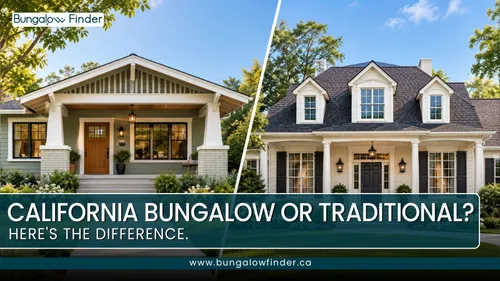
Townhouse: A narrow, multi-storey home built in a row that shares one or two side walls with neighbours and has its own entrance.
Bungalow Types
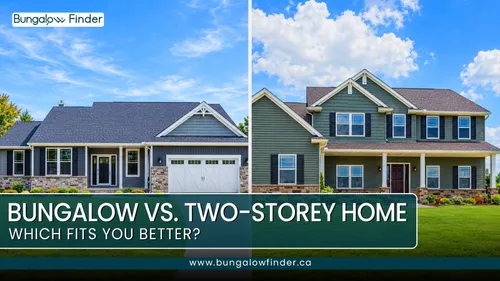
True single-storey bungalow: The entrance is near ground level with few steps, and all main living areas are stair-free.
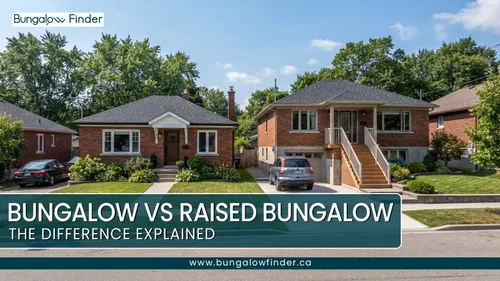
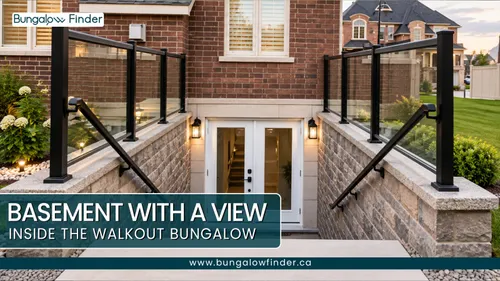
Raised bungalow: The foundation of a raised bungalow sits higher out of the ground, so the entry is mid-level and the lower floor gets large above-grade windows.
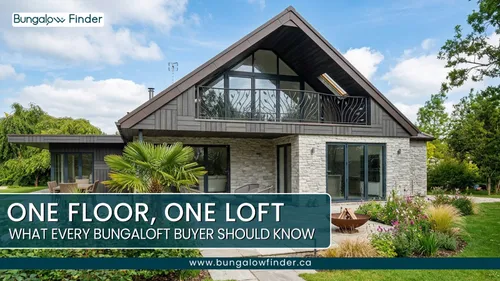
Bungaloft: A bungaloft has a bungalow-style main floor (with the primary bedroom and laundry) plus a partial second-floor loft for guests or extra space.
Condo and Townhouse Types
Condo apartment: A single-level unit in a low-, mid- or high-rise building.
Condo townhouse: You own the interior, and a condo corporation manages the shared exterior, roof and grounds for a monthly fee.
Freehold townhouse: You own the building and the land, with no mandatory condo fees and full responsibility for the exterior.
Stacked townhouse: Multi-level units stacked on top of each other, sharing walkways and structural elements.
Ownership Types Explained
Freehold: You own the building and the land and control maintenance, subject to municipal bylaws.
Condominium: You own your unit's interior and pay fees for the shared elements.
POTL (Parcel of Tied Land): You own a freehold home and lot, tied to a share in common infrastructure like a private road or visitor parking, with a small monthly fee.
Co-op: You buy shares in a corporation that owns the building, rather than owning real estate title.
Life lease: You buy the right to occupy a unit under a lease agreement with a non-profit sponsor. It is not governed by the Condominium Act.
Why Land Ownership Matters
A detached bungalow includes the whole lot. A freehold or POTL townhouse includes the land under the home and yard. A condo apartment does not include land. Owning land gives you control over your property and avoids condo corporation fees. Land is also the scarce asset that tends to drive long-term appreciation in Ontario's urban areas.
Where Does a Semi-Detached Home Fit?
A semi-detached home shares exactly one wall with a mirror-image neighbour. It sits between a detached house and a townhouse, with a wider lot and more privacy than a row home. A semi-detached can also be built as a single-storey bungalow, which gives buyers a lower-priced, stair-free option than a fully detached bungalow.
Prices: How Do the Three Compare?
Average prices from recent 2026 TRREB and WOWA data:
Area | Detached | Townhouse | Condo Apartment |
|---|---|---|---|
Greater Toronto Area | $1,292,016 | $820,637 | $605,257 |
Hamilton | $822,749 | $576,748 | $375,544 |
Detached figures cover all detached homes, not only bungalows. Bungalow-specific average prices were not reliably available.
Brampton: the average detached price is about $1,020,556.
Ottawa (benchmark prices): one-storey single-family homes about $691,600, townhouses about $506,100 and condos about $422,800.
Other cities: reliable price data by home type for London, Kitchener-Waterloo and Barrie was not available, and neither was reliable price-per-square-foot data for any of the three types.
Price change over the past year (GTA, TRREB): detached homes are down about 5.1%, townhouses about 4.6% and condos about 7.7%. Reliable five- and ten-year changes by home type were not available.
The price gap: The average GTA detached home costs about $471,379 more than the average townhouse. In Hamilton, the gap is about $246,001. That premium mostly reflects the land.
Monthly and Ownership Costs
Cost | Bungalow | Condo Apartment | Townhouse |
|---|---|---|---|
Monthly fees | None | Roughly $0.65 to $0.90 per sq. ft. | Freehold: none. POTL: commonly $50 to $200. Condo townhouse: varies |
Yearly upkeep | Rule of thumb: 1% to 3% of home value | Mostly covered by fees; owner pays interior costs | Freehold roughly 1%; condo townhouse is lower |
Home insurance (rough) | $1,200 to $2,500 | $400 to $800 | Freehold $900 to $1,600; condo townhouse $500 to $900 |
Property tax | Based on assessed value; often highest because of land | Typically lowest | In between |
Insurance and upkeep figures are rough estimates. Get real quotes for your property.
What condo fees cover: building insurance, common area maintenance, waste removal, amenities and the reserve fund. They tend to rise with inflation, and they do not stop.
Five-year cost illustration: A condo fee of $600 to $900 a month adds up to about $36,000 to $54,000 over five years. A bungalow has no such fee, but the owner carries roof, furnace, foundation and yard costs personally. Over time a bungalow can cost more in repairs, while a condo costs more in fees.
Mortgage and Down Payment Rules
Minimum down payment: Buyers can put just 5% down on the first $500,000 of the price and 10% on the portion above that, up to $1.5 million. Homes priced at $1.5 million or more need 20% down. These rules apply to all three types, but bungalows are more likely to cross the higher price thresholds.
Stress test: All buyers must qualify at their contract rate plus 2%, or 5.25%, whichever is higher.
Condo fees and your approval: Most lenders add 50% of the monthly condo fee to your debt ratios (GDS and TDS), which can reduce how much you qualify for. Freehold bungalows and freehold townhouses avoid this. POTL and common element fees are often counted in full.
Lender attitude: Freehold homes are generally the easiest to finance. For condos, lenders may review the building's reserve fund, lawsuits and the share of investor-owned units.
CMHC insurance and amortization: If you put down less than 20%, you pay a CMHC insurance premium (roughly 0.6% to 4.0% of the loan). First-time buyers and buyers of newly built homes can use a 30-year amortization on insured mortgages.
Status certificate: A legal document that shows a condo corporation's finances, reserve fund, planned fee increases and legal disputes. It applies to condo apartments, and to condo townhouses and POTLs with a corporation.
Taxes, Rebates and Closing Costs
Land transfer tax: Ontario's provincial tax applies to all types on a sliding scale. Toronto adds a municipal tax on top. Higher prices mean higher tax, so bungalows usually cost the most.
First-time buyer rebates: up to $4,000 provincially (covering the full tax up to about $368,000) and up to $4,475 in Toronto.
FHSA and HBP: The First Home Savings Account allows up to $40,000 in contributions, and the RRSP Home Buyers' Plan allows up to $60,000 in withdrawals. Both work for any of the three types.
New home HST/GST rebates: New-build rebates exist for primary residences but have price limits and eligibility rules. Confirm current amounts with the CRA before you sign a contract.
Principal residence exemption: Capital gains on your primary home are generally tax-free, whether it is a bungalow, condo or townhouse.
Closing costs (rough): legal fees and title insurance $1,500 to $3,000, a home inspection $400 to $600, and an appraisal $300 to $500. Condo and POTL buyers also pay for a status certificate review (about $100).
Space, Layout and Lifestyle
Bungalow: Large single-level floor plates, big basement storage, windows on all sides, and a private yard. Highest privacy and lowest noise.
Condo apartment: Typically the smallest footprint (often 500 to 900 sq. ft.), limited storage, light from one or two walls, and a balcony. Shared walls, floors and ceilings mean the least privacy.
Townhouse: Two to three floors, moderate storage, windows front and back only, and a small yard or patio. Moderate privacy with some noise through shared walls.
Families, pets and remote work: Bungalows suit families and large pets, and the basement can become a quiet office. Condos can be restrictive for large families and pets because of bylaws. Townhouses separate bedrooms from living areas across floors, which works well for work-from-home setups.
Parking, EV charging and access: Bungalows have private driveways and the easiest EV charger installation. Condo EV charging needs condo board approval. Freehold townhouses usually have a driveway or garage, but the stairs limit accessibility.
Amenities and transit: Condos generally offer the most walkability, transit and building amenities. Bungalows tend to sit in established low-density areas that are more car-dependent. Townhouses often sit near suburban transit hubs and family amenities.
Schools: Bungalow neighbourhoods are usually established with mature trees and stable catchments. Townhouse areas are often in growing family communities with newer schools. Dense condo areas may face crowded schools. Always check the school boundaries for the specific address.
Seniors, Downsizers and Aging in Place
Best for seniors: A bungalow is widely considered the best fit for independent seniors who want a house, a garden and no stairs. Condos suit seniors who want a secure, hands-off lifestyle. Townhouses are the hardest to age in because of the stairs.
Benefits of single-level living: fewer fall risks, easier movement and laundry and bedrooms on the same floor, which is why many retirees are downsizing to a bungalow.
Accessibility renovation costs (typical estimates): an exterior ramp about $2,000 to $5,000, a roll-in shower conversion about $10,000 to $25,000, and a home elevator about $35,000 to $65,000 (usually a townhouse problem). Condo changes are limited by building rules.
Maintenance for retirees: The bungalow demands the most physical work, such as snow shoveling, yard care and roof repairs. Condos remove it entirely. Freehold townhouses sit in between, and condo townhouses cover most of the exterior.
Downsizing from a larger home: A bungalow feels the most familiar, with a yard and a basement for belongings. A townhouse keeps several bedrooms. A condo requires the biggest lifestyle change and the most decluttering.
Investment and Rental Potential
Appreciation: Detached bungalows have historically appreciated the most because buyers own scarce land. Townhouses sit in the middle. Condos have appreciated the least, and growth has stalled recently because of oversupply.
Cap rates (commonly cited, not official): bungalows about 3% to 4%, condos about 3.5% to 4.5% and townhouses about 4% to 5%. Actual returns depend on your purchase price, rent and financing.
Cash flow: Condo investors face fees and recent rises in vacancy, so cash flow is often tight or negative with high leverage. Freehold townhouses avoid condo fees. Bungalows have no fees but cost the most to buy.
Rent control: Ontario rent increases are capped by the annual guideline (2.1% for 2026) for units first occupied before November 15, 2018. Units first occupied after that date are exempt. This applies to all three types.
Condo presale market: The presale market has slowed sharply, with unsold inventory and project delays, which has hurt condo investors. Bungalows are largely unaffected because developers rarely build them.
Land value advantage: A bungalow owner holds the entire lot, which tends to appreciate while the structure ages. Condo owners hold no individual land. Freehold townhouse owners own the land under their home but with less redevelopment potential.
Risks and Red Flags
Bungalow: The main risks are your own repair bills. Check the foundation for cracks or bowing walls, old wiring (knob-and-tube or aluminum), asbestos, buried oil tanks, the roof age and old sewer lines. Red flags include unpermitted basement apartments and damp smells.
Condo apartment: Look out for special assessments (lump-sum bills that can run from several thousand to tens of thousands of dollars), fee increases and poor management. Review the status certificate for a weak reserve fund, lawsuits and a high share of investor-owned units.
Townhouse: Shared-wall noise, fire separations in shared attics, roof age, and maintenance disputes with neighbours over roofs and fences. For POTLs, check the reserve fund for common roads. Mismatched shingles can signal a maintenance stalemate. Condo townhouse corporations can also issue special assessments, so a damaged shared roof or driveway can mean a sudden lump-sum bill, just like in an apartment building.
Buying pre-construction: Delays, cancellations and closing-price risk are real. Tarion protects deposits up to set limits and offers delayed-closing compensation, but the limits differ by home type. Confirm the current amounts with Tarion before you sign.
Rules, Zoning and Future Potential
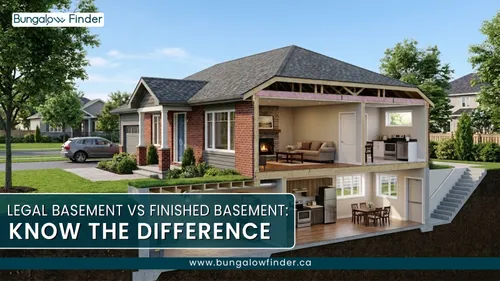
Basement apartment or secondary suite: A bungalow is the easiest to adapt thanks to its large footprint and basement. A freehold townhouse may allow one, but the narrow layout makes egress and fire separations harder. A condo apartment cannot add a suite.
Additional units and garden suites: Ontario rules generally allow up to three units on many urban lots, including a detached garden suite, subject to local servicing and zoning.
Condo bylaws: Condo apartments and condo townhouses may limit renovations, pet numbers or sizes, rentals and even exterior details like door colours. Freehold owners follow municipal rules only.
Short-term rentals: Toronto generally limits short-term rentals to your principal residence, with registration and a cap on nights per year. Most condo corporations ban short stays altogether.
Expanding or rebuilding: Bungalow owners can add a second storey, build an addition or tear down and rebuild, subject to zoning and permits. Condo owners cannot change the structure. Freehold townhouses allow only limited changes because of shared party walls.
New vs Resale
Bungalow: New bungalows are rare and expensive because of land costs. Resale bungalows offer mature lots but may need updating.
Condo: New condos offer modern features and warranties but are priced at a premium with long completion timelines. Resale condos often offer more space and faster move-in, and the current oversupply favours buyers.
Townhouse: New townhouses offer builder warranties and current designs, often with developer incentives. Resale townhouses give established communities and a visible condo corporation history.
Timelines and deposits: Detached builds are typically the shortest, townhouses somewhere in the middle, and high-rise condos the longest, often several years, with staged deposits.
Developer fees and adjustments: Expect extra charges at closing, such as utility connections, development charges and Tarion enrolment. Amounts vary widely, so ask for a full list before signing.
Best new-build value now: Townhouses currently look like the strongest new-build value, since developers are focusing on low-rise projects and offering incentives. Newly built condos face competition from discounted resale units.
City-by-City Guide
These are general patterns, not rules, and bungalow buyers weighing Mississauga against Oakville should compare lot sizes and prices closely.
Toronto and Mississauga: Condos are strongest for transit, walkability and urban living.
Milton and Oakville: Townhouses work well for families who want good schools and parks without detached prices.
Hamilton and Brampton: Detached bungalows in established neighbourhoods offer larger lots for less than the wider GTA.
Most bungalow supply: Older urban grids and mid-sized cities with post-war housing, such as Hamilton, Barrie, Oshawa and Peterborough.
Best townhouse supply: Growing suburbs like Brampton, Milton and Whitby.
Best value outside the GTA: The Niagara Region and London for detached homes, Kitchener-Waterloo for condos, and Hamilton and Cambridge for townhouses.
Which One Should You Choose?
By Budget
Around $500,000: A condo is the realistic choice in most of the GTA. Detached bungalows are not available in urban Ontario at this price, and townhouses are limited to entry-level or distant options.
Around $800,000: Townhouses open up in markets like Milton and Brampton. Outside the GTA, a resale bungalow or semi-detached home becomes possible.
Around $1.2 million: A detached bungalow becomes realistic in suburban areas like Brampton or Hamilton.
By Buyer Type
Single buyer or young couple: Condo, for a low-maintenance lifestyle near transit.
Family of four: Townhouse or bungalow, depending on budget and need for a yard.
Retiree: Bungalow or condo, since both avoid stairs.
Investor: Freehold townhouse for the steadiest cash flow, or a bungalow for land appreciation. Condos are harder going right now.
When Each Wins
A bungalow wins when you want land ownership, no corporate fees, structural freedom, maximum privacy and stair-free living.
A condo wins when you want a lock-and-leave lifestyle, walkability, security and a lower purchase price.
A townhouse wins when you need more bedrooms and space than a condo offers but cannot afford a detached lot.
Pros and Cons
Home Type | Pros | Cons |
|---|---|---|
Bungalow | Land ownership, privacy, no corporate fees, stair-free | High price, owner handles all maintenance, higher heating and roof costs |
Condo | Lower entry price, turnkey, security, transit | Fees that keep rising, no land, strict bylaws |
Townhouse | More space per dollar, private outdoor space, cheaper than detached | Stairs, shared-wall noise, POTL fee complexity |
Common Myths and Mistakes
Bungalow myth: Single-storey homes are not automatically cheaper to maintain. A larger roof and foundation can cost more to repair.
Condo myth: Condo fees do not cover everything. Underfunded reserves can lead to special assessments.
Townhouse myth: Not every townhouse is freehold. Always check whether it is freehold, condo or POTL, and read the fee details.
Market Trends for 2026 and 2027
Bungalows: Supply is tight because many owners are staying put to age in place, and developers often buy older bungalows to replace them with larger homes. Demand from retirees, families and investors remains strong, and many housing market predictions for 2027 expect bungalow supply to stay constrained.
Condos: Prices have corrected for several years, inventory is high and presale projects have been delayed or cancelled. TD Economics has forecast further softness before stabilization in 2027, but forecasts can change.
Townhouses: Prices have softened less than condos, and low-rise construction is expected to become a bigger share of new supply.
Interest rates and population growth: Lower borrowing costs help all three types, but the effect on condos depends on investor demand and slower population growth.
Final Thoughts
There is no single best answer. A bungalow is the strongest choice for buyers who want land, privacy and stair-free living, and who can handle the upkeep. A condo works for buyers who want a lower price and no maintenance. A townhouse is the middle path for families who need space without a detached budget. Start with your budget, your stage of life and how much maintenance you are willing to take on. Then check ownership type, fees and risks before you make an offer.
Disclaimer: This article is for general information only and is not financial, legal or tax advice. Prices, rates, rebates and rules change often. Confirm current figures with TRREB, CMHC, the CRA, your lender, your lawyer and a licensed real estate professional.
FAQs
Is a bungalow better than a condo in Ontario?
It depends on your priorities. A bungalow gives you land ownership, privacy, no condo fees and stair-free living, but you handle all maintenance. A condo costs less upfront and is lock-and-leave, but monthly fees keep rising and you own no land.
Is a townhouse cheaper than a bungalow?
Usually yes. In the GTA, the average townhouse is about $820,637 compared with about $1,292,016 for the average detached home, a gap of roughly $471,000. Townhouses use narrower lots and shared walls, which lowers the land cost.
Are condos a good investment in Ontario?
Condos currently face challenges. Prices have corrected, inventory is high, and monthly fees often squeeze cash flow, especially with high leverage. They can still suit some investors, but townhouses and bungalows have generally held value better over the long term.
Which is best for seniors, first-time buyers and families?
Bungalows suit seniors who want stair-free living, and also work for families who want a yard. Condos suit first-time buyers on a smaller budget. Townhouses work well for families who need bedrooms and space without the price of a detached home.
What are the hidden costs of each type?
Bungalow owners pay for repairs such as the roof, foundation and furnace. Condo owners face rising fees and possible special assessments. Townhouse owners may pay POTL or common element fees, plus shared roof and exterior costs. Always budget extra beyond the purchase price.
Is condo ownership cheaper than owning a bungalow?
Upfront, usually yes. Over time it depends. A condo fee of $600 to $900 a month adds up to roughly $36,000 to $54,000 over five years, while a bungalow has no fee but carries repair and upkeep costs. Compare total costs, not just the price.
Do townhouses appreciate as well as detached homes?
Townhouses generally appreciate better than condos because freehold and POTL owners hold land. They tend to trail detached homes, because the narrow lot offers less redevelopment potential and the land value is smaller. Results vary by city and neighbourhood.
What is the minimum down payment for each type in Ontario?
The rules are the same for all three. You need 5% on the first $500,000, 10% on the portion above that up to $1.5 million, and 20% for homes priced at $1.5 million or more. Some bungalows may cross the higher thresholds.
Are condo fees tax deductible?
Not for your principal residence. If you rent out the unit, condo fees can generally be deducted as an expense against rental income. The same applies to townhouse condo or POTL fees. Speak with an accountant for your situation.
Which type is easiest to resell?
Bungalows and townhouses are usually the easiest because they appeal to a wide pool of buyers, including downsizers and families. Condos can take longer to sell during periods of high inventory, when buyers have more negotiating power.
Is single-storey living better than living with stairs?
For mobility and aging in place, yes. Single-storey living reduces fall risk and keeps bedrooms, bathrooms and laundry on one level. Condos offer this inside the unit, while multi-level townhouses can become hard to manage as people age.
Where does a semi-detached home fit between a bungalow and a townhouse?
A semi-detached home shares one wall, so it sits between a detached house and a row townhouse. It generally offers a bigger lot and more privacy than a townhouse at a lower price than a detached home, and can be built as a bungalow.