Ontario Mortgage Renewal Strategy 2026: Leveraging Your Bungalow’s Land Value
Facing the 2026 renewal cliff? Learn how an Ontario mortgage renewal strategy 2026 can leverage your bungalow’s land value into a cash-flow asset.

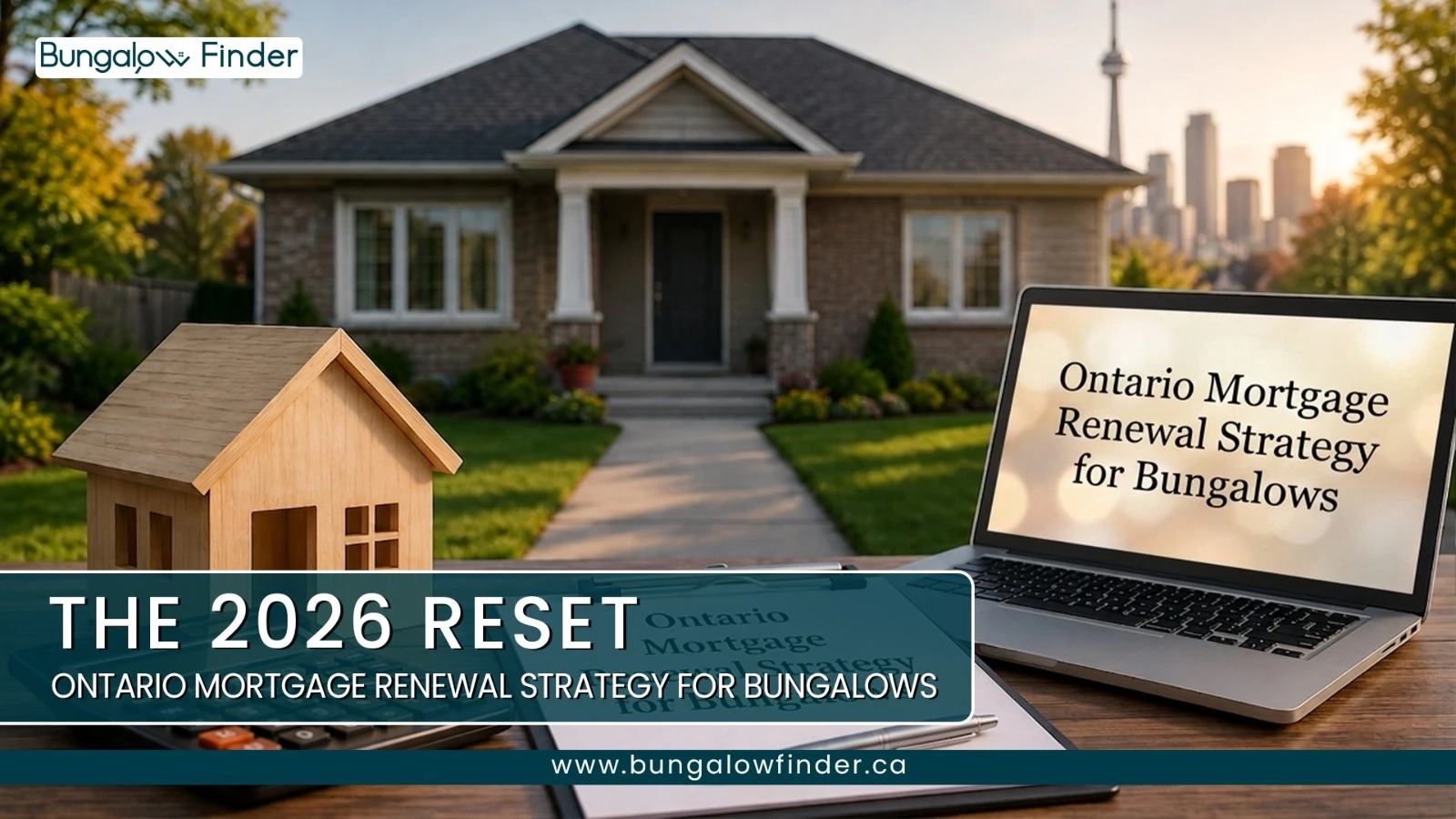
With the 2026 Mortgage Renewal Cliff Looming, an Ontario Mortgage Renewal Strategy 2026 Focused on Leveraging Your Bungalow’s Land Value Could Be the Difference Between Losing Your Home and Turning It Into a Cash-Flow Positive Asset.
A lot of Ontario homeowners are quietly landing in the same place right now. Not a dramatic crisis, just that moment where a renewal letter sits on the table a little longer than expected before anyone opens it properly.
Why The Wave of Renewals?
Most of these mortgages go back to 2020 or 2021. Low rates, easy approvals, and a sense that monthly payments were stable enough not to think too far ahead.
Now that the renewal cycle is here, the shift is showing up in a very direct way. Higher payments. Less flexibility in monthly budgeting. And for many households, that small gap between “manageable” and “tight” is suddenly noticeable.
It doesn’t always trigger immediate panic, but it does change how people think about staying put long term. And in that exact moment, bungalow owners end up in a slightly different position compared to most housing types in Ontario.
What’s Actually Happening Around 2026 Renewals
The renewals hitting now are heavily concentrated from the same low-rate period, which means the adjustment isn’t gradual across years — it lands almost all at once.
That’s part of why it feels sharper than previous cycles. It’s not just a rate change; it’s a collective reset happening across thousands of households at the same time.
Once the new payment shows up, it quickly becomes the anchor point of the monthly budget. Everything else adjusts around it — spending, savings, even long-term plans that weren’t originally tied to housing decisions.
And once that adjustment starts, most homeowners naturally begin looking for space somewhere in the system, not necessarily outside the home, but inside it.
That’s where bungalow layouts start to matter differently.
Why Bungalows Keep Coming Up In This Conversation
Across Ontario, bungalows tend to sit on lots that were never fully optimized for income use. Full basements that were built for storage or family expansion, not rental potential. Backyards that were never designed with secondary structures in mind, but still have the physical space for them.
On paper, nothing about that looks unusual. It’s just standard residential use.
But once monthly costs increase, unused space stops being neutral. It becomes something that can either stay idle or start contributing in some form.
Most homeowners don’t initially frame it that way. It’s still just a house, one unit, one cost, one responsibility. But financially, the structure starts behaving differently when pressure enters the picture.
Where Rental Income Usually Begins
In most bungalow cases, the basement is where things start shifting first. It already exists structurally in most homes, so the changes required are usually about usability rather than rebuilding. Access, finishing, basic separation — enough to turn it into a livable unit.
However, changing an older layout comes with its own set of hurdles, which we cover in detail in our guide on Basement Renovation Challenges in Ontario Bungalows.
From there, backyard space often enters the discussion. In many Ontario municipalities, garden suites have gradually moved from theoretical planning to actual construction. Not everywhere, but enough that it’s no longer unusual to consider.
Some homes also end up with smaller rental setups depending on layout — partial spaces or shared arrangements that don’t require full conversion but still generate income.
Individually, each change feels small. But together, they start changing how the mortgage sits in the monthly picture.
What Changes When Rental Income Is Added
Change Made To Property | Renewal Impact | Rental Range | Monthly Outcome |
Basement Converted To Unit | +$700–$1,000 | $1,600–$2,200 | Mortgage Pressure Absorbed |
Backyard Garden Suite Added | +$900–$1,300 | $1,800–$2,800 | Can Offset Or Exceed Increase |
Partial Rental Setup | +$400–$700 | $800–$1,200 | Noticeable Relief |
No Changes Made | Full Increase | $0 | Full Pressure Remains |
The actual numbers vary depending on city and property condition, but the underlying pattern stays consistent. Once rental income enters the equation, the mortgage stops acting like a one-directional expense.
Equity Is Already Sitting Quietly In The Background
Most homeowners in Ontario don’t actively engage with their equity until something forces attention toward it, and renewal cycles tend to be one of those moments.
That’s where tools like a Home Equity Line Of Credit (HELOC) Ontario often come into play, not as an end solution, but as access to capital already tied to the property.
If you are wondering which upgrades will give you the best return on this capital, see our breakdown of Bungalow Renovations That Deliver the Highest ROI in 2026.
In practice, that capital usually gets directed toward changes that affect usability — finishing basements properly, upgrading utilities, or adjusting layouts so a space can function as a legal or semi-legal rental unit.
The important detail isn’t the borrowing itself, but what it becomes after it’s used. If it creates rental income, it shifts from cost to structure. If it doesn’t, it simply adds weight on top of an already increased mortgage.
Refinancing Only Matters When It Connects To Function
The conversation around Refinancing Bungalow For Rental Suite has become more common as renewal pressure increases, but refinancing on its own rarely changes the core situation.
It restructures the mortgage, sometimes improves short-term cash flow, and sometimes unlocks equity. But the real impact only shows up when it connects directly to a rental outcome.
A finished basement suite that is actually rented changes how the monthly numbers behave. The renewal increase is no longer sitting alone — it gets partially absorbed into income generated from the property itself.
Without that layer, refinancing mainly spreads pressure over a longer timeline rather than reducing it.
Relief Tools And Why They Only Go So Far
Some homeowners explore Mortgage Payment Relief Canada options when renewal numbers first come in higher than expected.
These options can adjust payment timing, extend amortization, or temporarily ease monthly strain. In the short term, that can create breathing room.
However, navigate this carefully as the underlying rules are tied to the broader Mortgage Stress Test and Interest Rates for Canadian Homebuyers.
But the structure of the mortgage doesn’t fundamentally change.
That’s why many households gradually shift their focus away from temporary relief and toward more structural adjustments tied to income generation.
Financing Only Works When The Outcome Is Clear
Not every renovation fits neatly into traditional lending, especially when debt ratios are tighter after renewal.
That’s where Private Lending For Renovations becomes part of the conversation.
It offers speed and flexibility, but at a higher cost, which makes clarity essential before using it.
The scenarios where it tends to make sense are fairly specific — a basement suite that will be rented consistently, or a backyard unit with strong local demand. Something predictable enough that the income side can realistically support the borrowing.
Without that clarity, the risk side becomes harder to ignore.
Garden Suites Becoming Part Of Real Housing Strategy
Over the past few years, garden suites have slowly shifted from long-term planning concepts into actual housing decisions in parts of Ontario.
Bungalow lots are often central in that conversation simply because the land footprint already exists to support it.
If you want to see the specific regulations and financing options for these structures, you can check out our comprehensive Bungalow Garden Suites Ontario: The 2026 Multi-Unit Investment Guide.
This is where Second Mortgage For Garden Suites occasionally appears in planning discussions, usually when homeowners are considering adding a separate income unit without selling or relocating.
Once a second unit is built, the property stops relying on a single income stream. That structural change is often what reduces pressure during renewal cycles more than anything else.
Debt Consolidation Often Enters The Same Decision Space
For many households, mortgage renewal pressure doesn’t exist in isolation. Credit card balances, lines of credit, and older debts often sit alongside it.
That’s where Debt Consolidation Through Real Estate becomes part of the broader conversation.
It combines multiple obligations into one structure tied to the property, ideally supported by rental income that helps stabilize the monthly flow.
Without that income layer, consolidation mainly reshapes repayment rather than reducing total pressure.
Before Reacting, The Property Deserves A Closer Look
Most renewal decisions happen quickly because the new payment feels immediate and unavoidable. That reaction is understandable.
New density bylaws are changing how these lots are valued, which is why exploring The 2026 Guide to Toronto Bungalows: Investing in Land & Density can open up new financial avenues.
But bungalow owners often have something worth pausing for before making long-term choices — the actual physical potential of the property itself.
Basements that were never finished for independent use. Backyards that were never developed beyond basic residential use. Layouts that could support separation if needed.
Not every property will support rental conversion, and some clearly won’t. That’s part of reality. However, there are still enough properties that do so, making it worth evaluating the structure before making decisions based solely on the renewal number.
Because once the potential is visible, the decision changes shape.
Closing Thought
A practical Ontario Mortgage Renewal Strategy 2026 comes down to understanding how the home functions beyond its original use.
For bungalow owners, the situation rarely sits in a single direction. There’s usually more built into the property than what shows up on paper — land that isn’t fully used, basements that still have potential, and equity that has quietly built up over time.
What changes things is how the home is viewed at that moment. Some properties will stay exactly as they are, with nothing beyond a higher monthly number. Others will shift slightly, where unused space starts playing a role in how the mortgage is handled.
That small shift is often what separates pressure from stability over the long run.
FAQs
How can a bungalow help during mortgage renewal pressure in 2026?
Many bungalows have basements and extra land that can be converted into rental units. That added income can help balance higher mortgage payments after renewal.
Is a HELOC useful for rental upgrades in Ontario?
A HELOC gives access to home equity that can be used for renovations. It works best when spent on improvements that directly support rental income, like basement conversions or separate entrances.
Does refinancing reduce mortgage renewal pressure?
Refinancing can adjust payments or release equity, but it doesn’t solve pressure on its own. It becomes more effective when paired with a rental setup that brings in steady income.
Can all bungalow properties build garden suites in Ontario?
No, it depends on zoning rules, lot size, and local bylaws. Where allowed, garden suites are becoming a common way to add rental income without moving.
Is debt consolidation through real estate helpful during renewal?
It can simplify multiple debts into one payment tied to the property. It works best when supported by rental income that helps stabilize monthly costs.